"A Temporary Decline in Production Capacities" - The Bank of Russia's Phrase for Ukrainian Drones.

History has proven how events and data can be concealed in many different ways; however, when the effects start to be seen economically and socially, it becomes much harder to conceal. Yet institutions are generally cautious about saying the silent part out loud, hence why it is important to take statements and contextualise them.
As the CBR releases a statement about "A Temporary Decline in Production Capacities", it is important to remember that it was issued with the goal of stating the plan to "make rouble assets attractive to Russian households", hence why it does not include details or specifics on the reasons. To identify them, it is necessary to analyse its calculated vagueness and locate the real culprit, which, as expected, is linked to the escalation of the Russo-Ukrainian War.
The production capability specifically can be traced to the Kapotnya district, home of the Moscow Oil Refinery, one of the most important and vital refineries in the country, which has been struck multiple times.
The other omitted term is drones, key to the Ukrainian retaliatory effort and responsible for the attacks on Russian refineries. The result is the outcome veiled in the original statement: production down and in some cases completely halted, and not expected to restart before the end of 2026 or later.
Considering the responses given by the Bank of Russia's Governor, Elvira Nabiullina, to the questions by journalists, this analysis seems to be confirmed as the "quiet part", ultimately painting the overall meaning of the euphemism as follows: Ukrainian drone strikes have hindered the refining industry and supply chain to the point that the shock has reached the Bank's reaction function, altering monetary policy altogether, as it poses a threat to the entirety of the rouble-based economy.
The valuation of the Russia market follows a sort of discounted cash flow model, which is set by the Bank of Russia. A denominator in this model or the key (interest) rate is the most important figure in an economy, and Russia’s has been falling for over a year now. In April 2025 the Bank held it at 21% and then cuts at ten consecutive meetings.
At its meeting on 11 September, the Board held the key rate at 14%, breaking a run of ten consecutive cuts stretching back to June 2025. The narrowing this article traces — 200 basis points, then 50, then 25 — has reached its endpoint.
The Governor gave the fuel market as the main reason for the summer acceleration in prices, and confirmed the mechanism this piece describes: the direct effect of petrol and diesel prices in June has since spread into business costs, inflation expectations and demand. Measures of underlying inflation moved up into the 5–6% range in July, above the band held through the spring.
Resuming cuts is now conditional on the same thing. The Bank says the decline in underlying inflation should return once one particular set of effects fades.
Under standard economics theory, this is seen as a textbook disinflationary easing cycle. But if we read it as an incremental series we find something different. At the beginning of the interest rate reduction they were reduced by 200 basis points, to 50 for about a year then twice at 25bp. And now, with the newest press release the key rate has stayed at 14%, marking the end of the ten consecutive cut policies.
In June this year, the Board decided on a smaller step on fiscal policy, warning that a looser three-year budget would require a higher rate path than what the baseline assumed in April. Interestingly, motor fuel appeared in the potential risks paragraph in the analysis of the statement. Russia’s top economic officials claim that due to a temporary decline in fuel production there are evident proinflationary risks. About a month and a half later, the same potential risk turned into a materialized reaction from the Bank - the board citing direct effects of the temporary fuel production decline. Essentially, the physical supply shock, caused by Ukraine’s drone strikes turned from a potential hazard into something requiring a response.
To explore why this happened we are going to look at the seasonally adjusted growth rate - a statistical measure that omits calendar, predictable biases from the data. Current data on the same statistic suggests growth averaged 4.3% in Q4 of 2025 and 8.7% in Q1 of 2026. Further, the spike was identified in volatile components of the basket, rather than as a whole, indicating that the supply shock had gotten to some products specifically. Core inflation ran at 6.2% and by April-May the current seasonally adjusted growth rate had fallen to its lowest reading of the cycle at 2.1%. The Bank's July release then put the second quarter as a whole at 5.0%. Since April and May contributed 2.1%, effectively all of the quarter's acceleration occurred in June, at a monthly rate in the region of 10 to 11% annualised. Therefore, we can deduce that disinflation did not slow, but it reversed inside a single month, which turned out to be the strike wave peak.
As you can imagine, with the rise in fuel prices the bank's yearly inflation forecast moved from 4.5-5.5% for 2026, presented in June to 6.0-7.0% now projected in July. Most importantly for this worse forecast the bank gave one reason: a considerable rise in fuel prices. This change equates to a 150 basis points revision in the full yearly inflation, is not an inconsequential amount, and most importantly signals the bank’s acknowledgement of the issue. Considering all, the Board also raised the project average interest rate to 14.5-14.6% for 2026 and 10.5%-12.5% for 2027. Further, it cut its economy’s growth forecast to a projected 0-1% growth. To give perspective to these numbers, in April 2025 the baseline had put average interest rates at 13.0-14%. The Bank is easing into a downgraded growth forecast while lifting its own terminal rate assumption, which is not the configuration of an economy constrained by excess demand.
A very important line in the July statement deserves attention in order to objectively assess the situation. Although the board cut the policy rate, the interest rates rose in most segments of the financial market, meanwhile monetary conditions were easing in real terms, because inflation expectations had risen. A month prior to the disruptive strikes, market rate has still been falling except for the yield spike on long-dated government bonds (OFZ).
Subsequently, below all of this sits a labor market that is barely loosening. Private companies reported to the bank that it is slightly easier to hire, and wages have grown, but the truth is that almost nobody is unemployed in Russia and the pay is still climbing faster than output per worker. The problem is that the aforementioned description usually applies to strong labour markets, and this one is approaching the opposite. There are simply not enough workers, and no policy that the Central Bank sets can produce more of them.
Without a strong labour market, something else must be funding the war, which is seen in the shift from the Russian National Wealth Fund (NWF) to the domestic Federal Loan Obligation bonds (OFZ). This switch turns the banking sector into the balance sheet of the war.
For a bit of context, in the first quarter the Russian spending deficit hit RUB 4.6trn (~2% of GDP), which was already more than the 1.6% deficit initially planned for the entire year. In addition, oil and gas revenues were down 50.2% y/y in January, and Urals hit a $39 discount at $59. Finally, the NWF held RUB 3.6trn in liquid assets by the end of April.
What does this mean? Having a higher deficit than expected is not too surprising, as Russia is in a war; however, having their entire year's worth of deficit in just Q1 means that there are either some serious spending issues or issues in demand (GDP is down). Seeing as Urals oil is projected to be $39 discounted, that indicates very weak demand for Russian oil, which is also seen in the 50.2% revenue shortfall. This shortfall is probably due to the economic restrictions placed on Russia, which led to fewer countries buying their oil. In addition, having their liquid assets at RUB 3.6trn, about a quarter of the fund's total value, means that the banking sector is preparing for the need for a heavy cash flow.
Why does it matter? The major question being asked about the finances of the war is whether the OFZ market will have the capacity to take over and absorb the costs, and whether the Ministry of Finance will be able to ensure the switch happens in a smooth fashion. The Ministry of Finance is issuing large volumes of OFZs to attempt to finance the deficit and war-related spending. In order to do this, its auction schedule shows a planned large influx of listings (new bonds of up to ten years will add 900 billion roubles, while bonds of over ten years will add 600 billion, according to the Ministry of Finance website). While the concessions for these bonds are still unknown, due to the higher-than-expected deficit, one can expect a structural concession rather than a purely financial one. So the Ministry of Finance has the tricky job of increasing its spending capabilities through new bonds that attract investors, but doing it in such a way that they do not saturate the market.
Russian banks are currently holding large sums of these bonds at 14% yields, which is really high; however, they also have large sums of wartime loans at low rates. What this means is that the banks were forced to give out loans on which they would lose money to support the war, but are then rewarded with high-yield bonds to offset the costs. This creates an imbalance in which the banks are relied on for both the budget, through the OFZ bonds, and the war funding, through the loans. This imbalance can lead to liquidity shortages in the banks, especially if their yields fall and losses rise. Longer-term effects could be that banks demand higher compensation for their bonds or loans, that interest rates rise, that banks become too focused on trying to stay open rather than on monetary policy issues, and that private investment slows. All of this leads to strain on the economy and monetary cash flow, which weakens the banks and the Ministry of Finance.
What has actually been happening is that long-term yields for the OFZ have risen, while the monetary policy rate has fallen. This mismatch between the official figures and what investors are demanding leads us to use long-term yields as a more trustworthy indicator for macro issues. This divergence between official rates and market-driven prices shows that investors believe the government will borrow more, inflation will rise, and monetary policy is losing traction. A switch in the anchor of the financial system during a volatile time, such as wartime, can lead to liquidity stress and wartime credit distortion. Investors are trying to find financial safety in long-term markets rather than risking it on short-term profit, but this may weaken the economy even more, causing higher deficits and more instability.
Now onto what caused the Bank of Russia to correct interest rates and clearly distress the federation’s economy. Data shows that by late July, Russian refineries with annual capacity of about 45 million tonnes were sitting idle. Refineries, responsible for another 40 million tonnes, had come back to operations after emergency repairs. Of course, there is no telling how mended said facilities are, but considering the swift reaction of authorities it is safe to assume that the further 40 million have caused chaos amid the Russia war economy. At least 10 refineries stopped work at some point during June and July. As a result, petrol output fell by roughly a quarter and diesel by 40%. The Industry estimates that a full restoration would take at least two months, granted there are no other damaged facilities in the future. Of course, by all means that is not a safe assumption as military actions intensify.
Additionally, the oil and gas refineries that stopped operating aren’t obscure, nor small. Within three weeks the list took in Gazpromneftekhim Salavat, Rosneft's refineries at Syzran and Saratov, Gazprom Neft's plant at Omsk, and Lukoil's at Nizhny Novgorod.
The refinery near Moscow, by the name of Kapotnya, belonging to Gazprom Neft which supplies the capital city took the worst hit from the Ukrainian attacks. Repairs of these facilities are reported to run into 2027 with a cost of a billion dollars. As of August 2026, every listed oil producer in the country had a refinery hit.
The obvious consequence to all of this is decreased supply of fuel, and the less obvious one is arguably more important.
Fundamentally, a refinery turns crude oil into petrol and diesel, which in turn sells for more than the crude it came from. Essentially, the clients pay more for the final product, while with broken refineries the crude does not stop arriving. It just gets sold at a considerable discount, into a market that already has Russian barrels priced lower than everybody else’s. Just in the first half of May, Russian exports of refined products fell to 2.2 million barrels a day - literally the lowest figure on record, ever. Subsequently, the exports of crude oil climbed up to 4.9 million barrels. Total exports were down slightly on the month and down by nearly half a million barrels a day on the year.
What Russia really is losing is the profit margin for selling the cheaper crude, rather than the refined byproducts such as petrol and diesel. And that loss of profit margin occurs regardless of how many barrels leave the country. While volume figures circulating the media seem to be fine, the underlying issue is still present.
So the next logical question would be who absorbs the damage. The answer is technically a hidden subsidy that is largely not talked about. Russian commercial petrol prices at the pump are not a product of supply and demand, but a political show. They are held down, and refiners could always earn more by selling abroad. It is completely logical that an enterprise would prefer to sell at a higher price, therefore the state pays them the difference. This mechanism is known as the damper and has operated in Russia since 2019, month by month. When exporting would be more profitable, the state pays the refiner to keep it in the country. When the home market is better the refiner pays the budget.
As you can imagine the sum of these subsidies is not insignificant at all. The budget allocation for this initiative was 2.17 trillion RUB ($25.26bn) in 2022, 1.59 trillion RUB ($18.5bn) in 2023 and 1.82 trillion RUB in 2024 ($21.2bn). From a figure standpoint, this is one of the largest state expenditures of the Russian Federation.
But there is a catch in the tax code, if wholesale at home runs more than 10% above for petrol and 20% diesel than the law mandated level the subsidy is cancelled. The logic behind this subsidy ceiling is that if the supplier is selling into a hot market, they are already making a good profit. And this mechanism has been triggered before and payments for September 2023 and August 2025 were cancelled.
Now let’s put beside the strikes, destroyed capacity equates to less fuel, meaning higher wholesale prices, and higher wholesale prices are the exact condition that cancels the subsidy. Due to low supply, the refiner loses on the output, due to the inability to produce and loses the compensation for the exact same reason. It is important to mention that a decree by president Vladimir Putin suspended the cancellation rule in October 2025, but it expired on the 1st of May this year. Just weeks before the prices hit new records.
Whether the rule has bitten since is the most valuable unanswered question here, and it is answerable from published Finance Ministry data. If the payments have stopped, shareholders are funding the drone campaign. If the suspension was quietly extended, the budget is, and the cost lands on the bond market described in the previous section.
What we can most prominently observe is just how little the state of Russia keeps, from what it produces. In April this year it collected 771 billion RUB in extraction tax and then returned 207 billion RUB in subsidy payments plus 152 in rebates for refineries. Put in percentages - 46% of the take home was given away. For the following month of May the state collected 873 billion RUB and returned back about 40%. Subsequently, revenues from oil and gas saw an increase of 34% on year, and yet the running total for the first five months of 2026 was still about 30% below the previous year. The prominent Russian economics and energy sector analyst Kirill Rodionov claims that the increase in subsidies largely cancels the growth in the revenue.
But the point to be made here is entirely different, even company accounts have not caught up. Rosneft Q1 earnings were strong with a net income 115 billion RUB, to a mere 16 billion RUB, three months later - closing right before the most fierce strikes. But this is the last clean business snapshot before the damage, and the baseline for reading the half-year figures. The CEO of Rosneft, Igor Sechin listed damage to refineries, depots and stations among the company’s fundamental risks. Rosneft was assessing whether to write down assets. There is a precedent. In the third quarter of 2018, caught between capped pump prices and expensive crude, Rosneft wrote off 133 billion RUB in refining and retail. The same squeeze applies now, and this time the plants have burned. Watch the write-downs, not the sales.
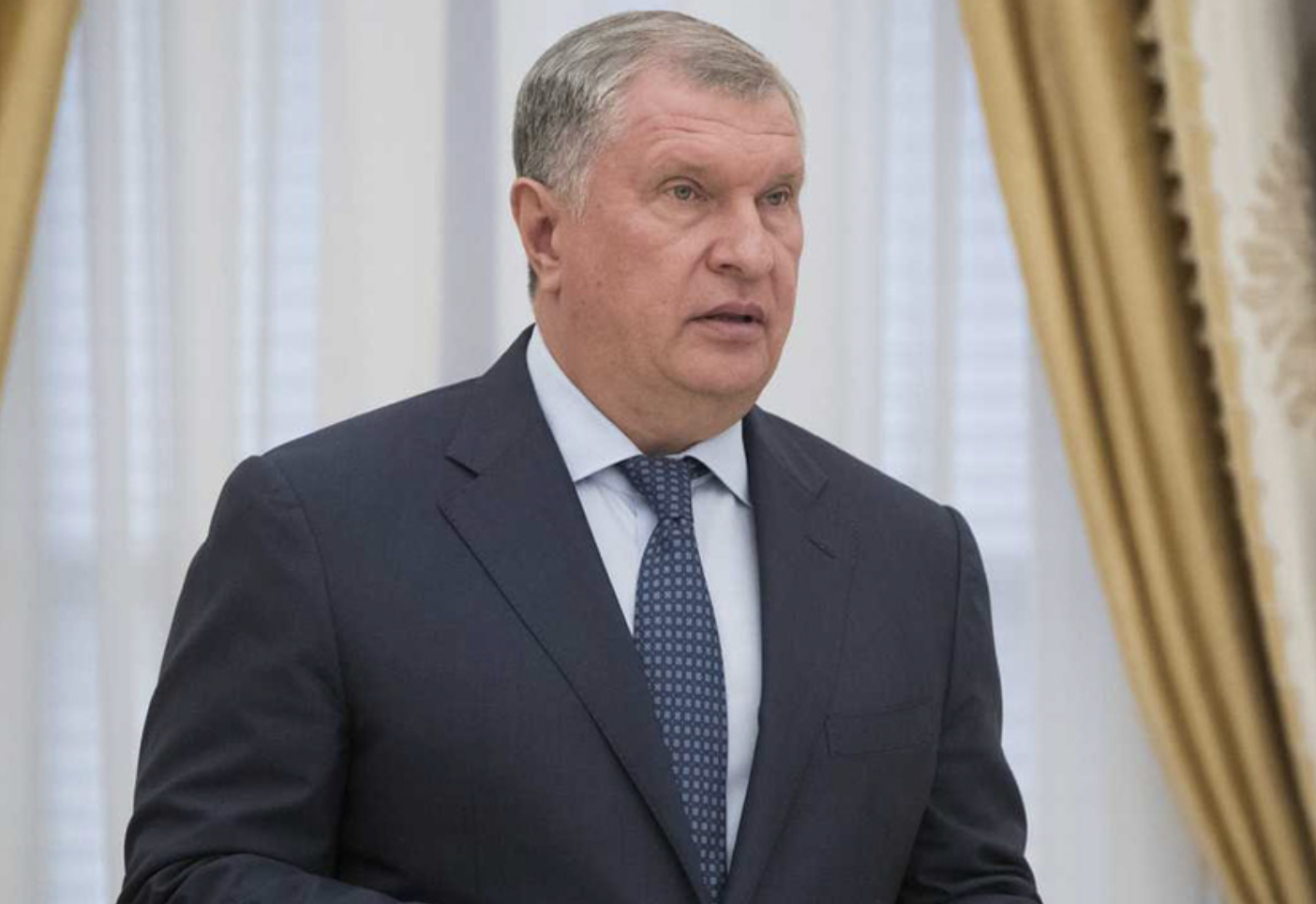
Igor Sechin, Chief Executive Officer Rosneft.
Another Russian oil giant, Lukoil, is the exception in this standardized post-strike scenario. In 2025 the company suffered a 2.2 trillion RUB loss and it came almost entirely from writing down foreign assets due to seizures from American economic sanctions. So, losses from the strikes and from political sanctions should not be confused.
So the circle is complete, the drone strikes destroy the refining capacity, petrol gets scarce, and rising fuel prices push inflation up. This in turn forces The Bank of Russia to raise its yearly forecast from 4-5% to 6-7% with fuel named as reason. As we would imagine the higher inflation would imply slower rate cuts, meaning a higher interest rate for longer. With a higher key rate, the Finance Ministry will have to pay more to borrow for the subsidies that are placed in order to hold down the fuel price. And that same fuel price is what started the entire chain.
When conducting this analysis one of the main concerns regarded the origin of the data and whether they are to be trusted or not, upon further inspection, this task results almost impossible as outsiders, therefore the actual assessment to be made is not how truthful the dataset is, but rather which numbers are consistent and credible and which are not. The first major inconsistency found is a distinctive withholding of around 600 datasets in the last three years compared to previous publications, these include but are not limited to: trade statistics, foreign reserve composition and monthly oil production figures.
Because of this lack of data, reconstruction and analysis must use external sources and estimates, hindering the accuracy of the study, but not necessarily its reliability; for instance, public data regarding exports volumes is lacking as Russian customs returns are withheld, which means that the values analyzed are reconstructed by using other countries reports and shipment tracking. As mentioned in the opening, the one of the main drivers of this variation is the constant Ukrainian hammering attacks on Russian petrol-chemical infrastructure, it comes as no surprise then that production numbers haven’t been made public, being a core product for the Russian economy.
Even if redacted, however, reconstruction can be attempted, with precise results, as the real focus is not the number itself but rather the result of its decrease: for the aforementioned case, for instance, the precise production numbers are insignificant so long as the estimations lead to the same result. News can also be factored in to reach the correct result: as more and more cases of gas stations running out of fuel are made public and shared on social media and traditional news outlets, it is clear that the strikes have achieved an almost total level of incapacitation of major Russian plants.
Cross referencing this with the videos of the attacks on the Kapotnya district, it is clear, even without official confirmation, that the infrastructure in the region has been rendered unusable for the time being. This connection is one example of how to supersede the omission of details by official channels to better understand the meaning behind vague wording going back to the original statement this article opened with.
In fact, with this reconstruction in mind the opening statement is much clearer and detailed: the temporary decline now refers clearly to the past three years of conflict plus the two estimated to turn the plants operative again, the production capabilities are now unmistakably tied to the refineries. Another set of analytic anomalies is found cross referencing data inside the Russian system itself, and it regards two major, government linked, institutes: Rosstat and CMAKP.
The first in fact reports industrial output estimates at an increase of around 14.5% compared to the 2021 pre-war average, while the second places the same at 11%, 3% is a significant percentage considering both institutes operate on the same set of internal undisclosed data; further more focusing of Rosstat’s projection of annual growth: using their own monthly publications the arithmetic result is 6.1% annual, while they themselves report an expectation of 1.9%, this much of a gap appears to be inexplicable.
This analysis seems to be damning, as it does not come from western sources, which could be accused of hostility, but from within the country itself, and yet, Russian data is not fabricated, and this has been proven by outside research. Heli Simola at the Bank of Finland Institute for Emerging Economies tested 31 Russian macroeconomic series for signs of corruption and fabrication using conformity to the Newcomb–Benford law, which describes the expected frequency of leading digits in naturally occurring data.
She also tested the sets against other factors, namely using mirror trade statistics to compare Russian declared flows with the ones reported by trading partners and internal cross-relationships to verify that series which were supposed to move together were indeed following the pattern. The ultimate result of this investigation was that there was no provable widespread manipulation of data; this is indicative of the fact that Russian sources do not fake their statements, but rather carefully place them to suit their internal needs and analysis.
The final point of analysis regards the counting process leading to GDP figures used by Rosstat: as a matter of fact, output numbers are calculated based on production numbers alone and do not account for unsold inventory, this results in products stored in deposits unsold and/or unable to be exported counting as growth albeit lacking a future (for now) income stream. For this reason, the analysis utilizes more telling figures, such as those regarding Obligations Federal Loans (OFZ) and their curve; using the zero-coupon yield curve for Russian federal government bonds, not only means using a source proven to be realistic, but it also leads to understand both long-term and short-term expectations from Russian Institutions themselves.
For starters, by definition a supply shock is temporary, analyzing the OFZ’s curve provides short term expectation or rates for immediate following years, while the long term indicates the average expected inflation rates during the life of the bond, showing both the reaction to the central bank’s decisions and expectations and what investors believe the interest rates will actually be.
In conclusion, it is not possible to have a perfectly accurate analysis as the underlying data itself is limited and tailored to specific internal interests; it is however possible to create a reliable study based on available data and real world effects, and it is crucial to admit to the shortcomings, as it makes the study more believable.
Another indicator of a weakening economy is a stagnating stock market. Without investment no growth can happen, which is why the stagnation in the Russian stock market is so worrying. In 2022, during the beginning of the Russo-Ukrainian conflict, the Moscow Exchange (MOEX) took a sharp hit, falling from a peak of 4,229 in October of 2021 to a low of roughly 1700 in February of 2022. Even in 2026, while improving slightly, the market is at roughly a 46% weaker position than it was at the peak in October of 2021 (around 2,262 points in August of 2026.)
The market has not bounced back for a variety of reasons, the main ones though are that there are fewer foreign investors, and that the economy is state driven now. Without foreign investors being able to re-enter the market, because of capital controls blocking them, the available sum of investors is nowhere near what it was during the market peak. Allowing less people to invest cuts off potential growth and money flow, leading to a weaker market with no chance of regrowing. In addition, by having the economy be state-run, the investment environment is not ideal. Investors prefer predictable policy, private-sector growth, and profit-driven incentives, but with the government controlling everything there is less focus on growing industries outside of defense. The only flow of money entering the market is dividend reinvestment, which is not enough to rebuild it to what it once was in such a short amount of time.
This year there was a massive dividend payout by Sberbank, valued at RUB 850bln. This would be one of the largest corporate payouts in Russian history, however, it is being perceived as a “quasi-fiscal extraction” dressed as a shareholders return. This is because the state owns a large stake in the company, so the payout would give the government a large sum of money without the need for tax raises or borrowing. This attempt to cover the deficit is presented as a healthy banking sector, but is actually just a well executed liquidity run so the deficit does not collapse the investment sector. What this does, though, is also create weakened balance sheets and depresses equity valuations, so while it gives the state some money to work with, while trying to look strong and healthy, it actually puts strain on the financial institutions and crowds out private sector credit.
Currently the market is showing that the equity premium means nothing, as there are no marginal buyers, nor is there an exit for the existing investors. With thin liquidity there is no way to reward the illiquidity in the market, so no one can buy at higher prices, nor sell at new prices. The current market is kept stable due to the fact no one can leave and no one is entering. This leads to the premium being irrelevant, so the only place to make any profit would be the OFZ yields. Theoretically, in a functioning market that rotation would already have happened and equities would have repriced down; capital controls mean it can't happen at all, but with political risk, no exit, and war-economy distortions it does not matter, because no one can act on the yields.
Because of the war, the MOEX has stagnated. The only economic information remaining comes from the Ruble exchange rate, and the OFZ yields. Equities and corporate bonds stopped mattering once liquidity was strained and no one could act further upon unrealized profits. The financial system has lost most of its signal, so to understand the economy we can only rely on the exchange rate and the OFZ yields.
As the general public yearns for a clear-cut answer it comes as no surprise that outlets supporting each side come out with statements overreaching reality, the Russian economy is not perfectly healthy, and yet it’s not in direct collapse.
The key to grasp the reasons for both positions is to understand that the Russian economy exists now in a setting of conflict, which fundamentally changes the way data is interpreted. Russia reports an adjusted lowest record of 2.1% unemployment, considering wartime employment, emigration and increases in the defense sector, this value shows how Russia has transitioned into a war economy which is now at full employment but incapable to answer to additional demand by increasing output.
This is proven by analyzing production numbers as well: production-based accounting registers output at production and delivery, therefore both ordnance sent to depots and other goods stalled as they cannot be exported are both considered growth. The reason for the 14% rates is the result of the pricing dictated by this conditions: it must sit this high because the weight of the borrowing is on those who borrow at market prices, namely civilians, as the focus is to maintain productivity and founding for the military defense contractors fueling the pipeline to Ukrainian battlefields.
Looking at footage and data collected during the first days of the “special operation”, supply was one of the main chokeholds, numerous videos and reports of lacks of firearm and bullets to the frontlines became viral, in particular the famous video of Yevgeny Prigozhin screaming insults at minister Shoigu and chief of general staff Gerasimov. Analyzing the situation today however, despite calls for a collapse since 2022, it is clear that the situation has evolved differently as the military apparatus seems to be appropriately supplied, however, the other core sector of the Russian economy has been struck in the meantime.
Ukrainian drone attacks have in fact been very successful in plaguing oil refineries and supply chains, creating a wound hemorrhaging money at an alarming rate, even still, the reaction from Russian authorities has been far from suggesting an impending crisis. The interest rates in fact, albeit kept higher than expected, are not at a critical level, and the value must be analyzed in the context of a nation at war, and not against peacetime counterparts.
This has created a cascade effect on the military efforts, as the revenues from the first are a substantial share of contribution to the second, and, when questioned, Alexander Zabotkin, Board of directors member of the Bank of Russia, has stated that there are protocols being prepared and studied in case the pressure from Ukrainian drones, combined with the more general struggles, would lead to stagflation. Predicting the future the way many have tried, and failed, to do is hard for a series of reasons, firstly, albeit the strikes have rendered important plants out of order, reparations have been made in the past and should be completed by next year’s end according to Russian sources.
The bottom line is that there is no secure way to know what the long-term effects will be: Ukrainian strikes will continue Russian efforts to fix what’s broken and prevent new damage. Will go on the current rate indicate that the Russian state for now has been able to manage the damage inflicted, not without struggles, Andy only provide a picture for the next 2 to 3 years; beyond this mark, there are simply too many variables, and two little data provided to be able to accurately predict a specific outcome. The ultimate goal of this study was therefore not to identify real numbers, or what the future will certainly look like, but rather to look at the real world and the end result to better understand the reasons behind the vagueness, knowing the volatility of the situation in the long term is far too high for a certain verdict, which is what many try to do, fitting the outcome to the narrative they want to push.
The conclusion hence is that the correct approach is to cross reference the original data with third parties to obtain a closer-to-reality number, and that decisions, press conferences and real life analysis matter more than the data itself to understand the true reality of things.