The Stand Before The Chair - Kevin Warsh
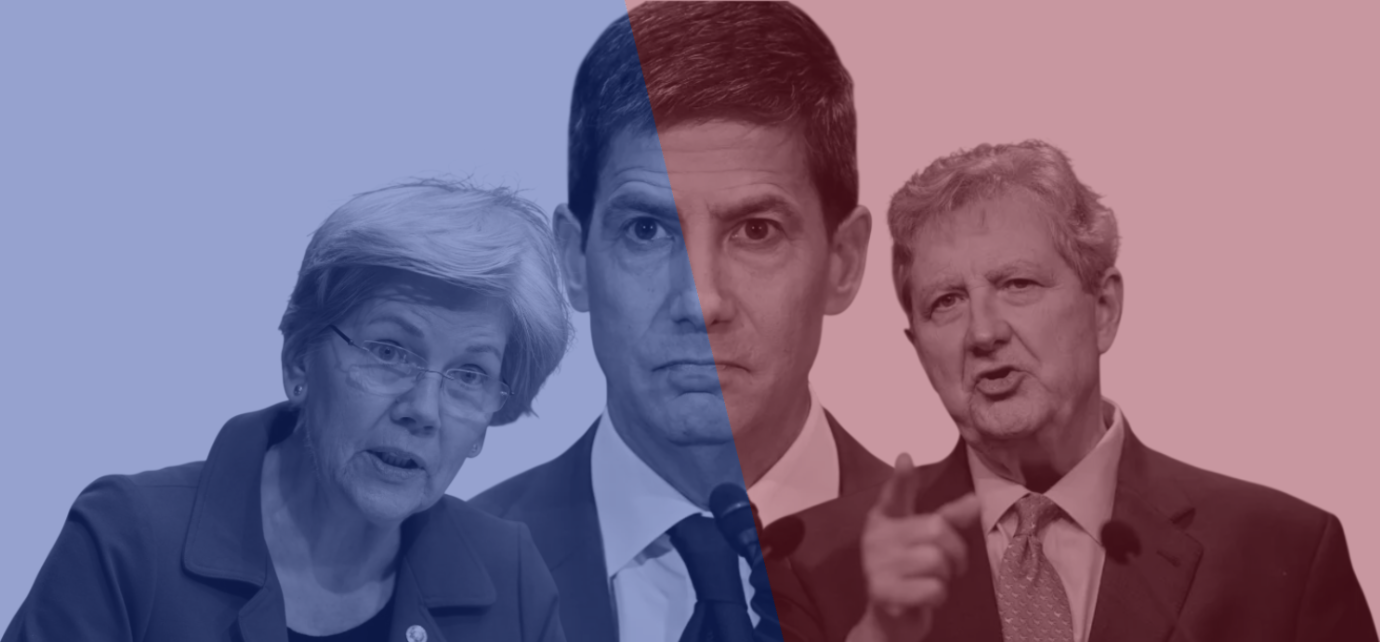
From left to right: Sen. E. Warren, K. Warsh, Sen J.N. Kennedy (Source: TFR)
Article Author: Giovanni Epifano.
IMPORTANT RECENT UPDATE
As of April 24th, the U.S. Department of Justice has confirmed the probe on J. Powell has officially been dropped, this does not constitute the end of the scrutiny overall, but it does remove one of the major obstacles discussed in the following article!
Introduction.
On April 21, 2026 Kevin Warsh, President Donald Trump's nominee to be next chair of the Federal Reserve, appeared in front of the Senate Banking Committee to testify as part of the process to be confirmed as head of the Fed after J. Powell’s mandate ends; it was a particularly tense situation as Mr. Warsh had to navigate a difficult two and a half hours of aggressive questioning by Democrats, more friendly exchanges with Republicans and an ever so thin wire between maintaining balance and impartiality and justification of future plans.
Considered the overall political situation, being so strongly vouched for by POTUS is not an easy position to start from, as many, even Republicans, have grown wary of possible rumors tied to an hypothetical strongly Trump-aligned agenda, all things considered however, Mr. Warsh navigated admirably the difficult situation, proving his ability to deflect criticism and remain impartial.
The last obstacle.
Albeit the strong support from the president, the hearing remained a crucial step in the ladder to becoming chairman as, without their approval, the nomination cannot be confirmed, the process is particularly tense in this case because of the friction between the senate and POTUS, and a strong favoritism from the latter doesn’t make the process easier for the candidate, rather casting a shadow of doubt on his intentions.
It comes to no surprise, considered the above, that the main remark of the hearing was the independence of the Federal Reserve, which Mr. Warsh remarked upon whenever he had the opportunity to, and although his remarkable ability to distance himself from previous rumours, some high level members, Senator Warren especially, did not seem fully convinced.
The probe.
Unprecedented is also the state of the transition as, albeit some Fed chairs where facing pressure as the successor was being vouched, this is the first time in which the predecessor (Jerome Powell) is actively being probed by the DOJ, on top of this there are two major facts to keep into consideration: the POTUS endorsement of Kevin Warsh as successor of Powell happened during a height of the conflict between the first and the latter, and secondly, rumours immediately surfaced regarding the alleged prioritary intention of the candidate to cut interest rates, an action strongly requested by Trump and in contrast with the current heading of the Fed.
This mixture of timing and ideals made it so that the endorsement hasn’t been analyzed with the remarkable pedigree and abilities of the candidate in mind but rather on a more rumour-based approach, and this explains why the main focus of the hearing was on remarking how Mr. Warsh wouldn’t be president Trump’s “Sock puppet”, expression used by Senator Warren, and more in general to assure the committee of his belief in the independence of the Fed.
As highlighted by Senator John N. Kennedy, a probe into a Fed chair is a fact resembling one in a “Banana republic”: a rhetorical expression indicating a ridiculous situation only fit for a government in disarray and a significant show of weakness; all of this coming from a republican senator shows how the hearing wasn’t as much on the future financial strategy, but rather on how separated from political affiliations it could be.
Kevin Warsh has avoided taking a direct stance on the investigation into Powell, however this situation creates a considerable issue as some, such as Sen. Tillis have stated their intention to delay or oppose the nomination until the issue is solved; issues on which the candidate did express his stance on, include the main ones of the hearing as he stated multiple times his strong belief in an independent Federal Reserve and declared his intentions of rate cuts an “after data assessment” issue rather than an immediate and non-negotiable stance.
Current financial position.
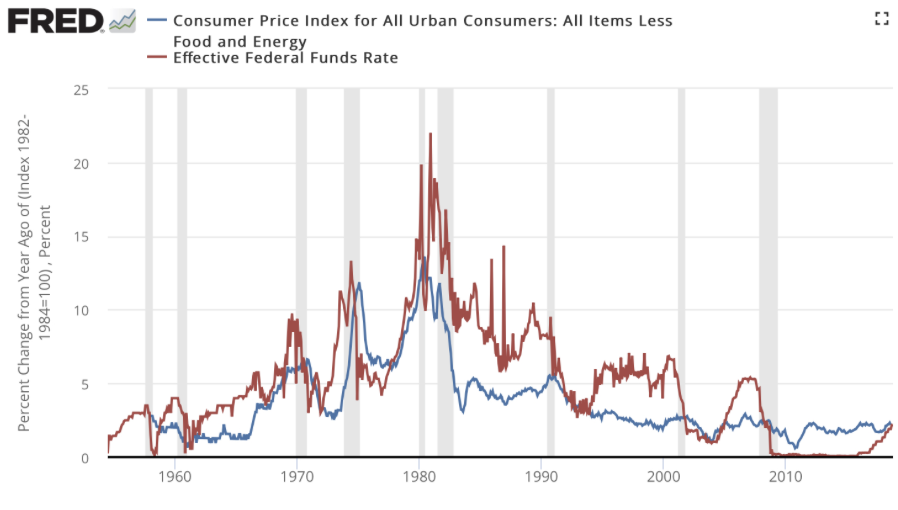
The graph represents the inflation compared to federal funds. (TFR)
The main issue between the Fed and the Trump administration has been on their position regarding Interest rates: the first is holding on higher ones and refusing to cut, whereas the second pushes strongly for a reduction as that is needed for them to maintain their political line which they were elected upon, numerous attempts were made to coerce the Fed to line up with the administration’s line, but up to now all failed as Jerome Powell maintains his stance while fending off attacks.
The decision the head of the Fed has made so far regarding rates is due to his aim to fight inflation in the long term, hence, even if the latter has been decreasing, it is still over the 2% target, therefore, lowering rates now could lead to a second wave of inflation, which is a scenario that already happened in the 70’s and that the Fed wants to avoid at all costs.
This decision however has many drawbacks: higher rates mean less return from investments in new activities, more caution from banks, lower consumption of goods, which together lowers the valuation of stocks, prevents people from spending and taking out more loans to use goods, and a decrease in new investments, all of which are seen as acceptable when the aim is to contain rather than expand.
This however is opposite to the political platform the current administration has been elected upon as the promised increase in fields such as GDPgrowth, business expansion and new jobs, hence why there is a strong interest in lowering the rates in order to obtain the results now, sacrificing increased security on long term outcomes and deviations.
A hidden aspect of this conflict, which is not merely financial lingers heavy on Kevin Warsh: the message behind change, as a matter of fact Powell refusal has communicated to the public a strong message of independence and stability of the Fed, therefore if he decides to ease the position if elected, even if this stance originates from previous and unrelated motives, the action might still be seen as a sign of weakness under pressure losing credibility.
Warsh’s position.
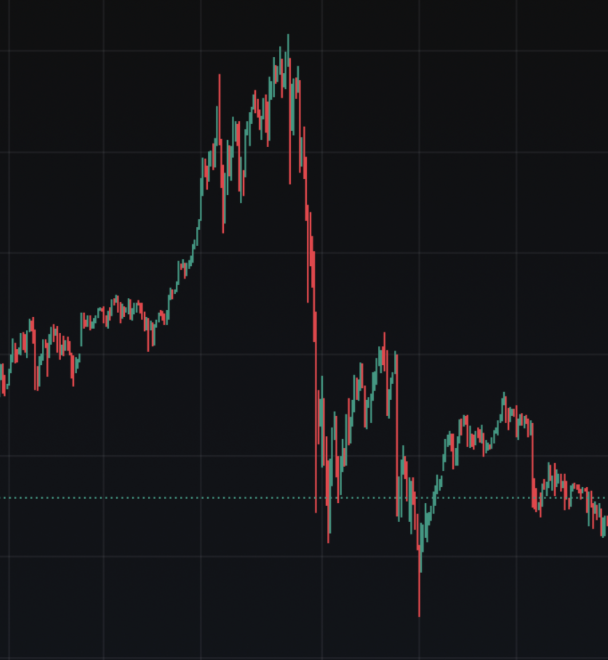
Price of traded Silver around Jan 30th 2026
As soon as the news broke of Kevin Warsh being Trump’s nominee to succeed Powell immediately the public, and consequently the markets, reacted strongly to the rumour of him being completely in line with the Trump administration on rate cutting, this can be seen looking at the price of silver around January 30 2026, it’s important to clarify that a series of other very important factors contributed to the crash, however this event certainly helped fomenting the reaction.
Crucially, it is important to separate speculation from reality, and so far these rumours of a man willing to give up control of the Fed to the government seem to fall extremely short: not only he clearly distanced himself from the requests for immediatecuts, he also remarked on the independence of the Fed, if anything, considering he was the main link between the Central Bank and Wall Street during the 2007/2008 financial crisis,his past positions him as a fit candidate to mediate between the two entities.
Even so changes are indeed in order, as he has already discussed them with the committee: first of all he intends to change the way inflation is measured as today the latter is calculated using core PCE data, which excludes food and energy, as their volatility can alter short term results, he would introduce a measure based on the median of large scale data analytics, which would make the calculation harder but more precise filtering out deceiving data.
Regarding the financial strategy, he is set to continue the current plan of the Fed to reduce its balancesheet, however he plans to be more aggressive with measures and do even more than the current strategy, which will most likely lead to a bigger shrinking than the currentprojections; more generally he seems to be aiming at a much more traditional approach to the role of the Fed in regulating the economy easing its presence in the markets.
Breaking off from the previous lead, he has also stated his intention to reduce guidance, announcing policy decisions closer to meetings, hence shortening the time between a strategy is adopted and the communication of the latter, this would allow for decisions to be made with more recent data and at the same time forcing markets to move based on real data and not on over-reliance on Fed announcements.
Conclusion.
Overall Kevin Warsh has expressed his belief that the Fed is too involved in controlling markets, which is something he intends on changing, at the same time he has clearly declared his intentions to protect the independence of the FederalReserve from government wishes, which was the major fear ahead of this hearing.
Another big point he has made is the rejection of immediate rate cuts: the decision will be taken only after a period of initial analysis and will be communicated shortly before implementation, putting an end to market movements based on declared decisions rather than actions taken.
However this hearing, albeit clearing many doubts, does not send a precise message to markets and analysts as major barriers are still between Mr. Warsh and the presidency of the Fed, in particular a clearer picture will be drawn only after Sen. Tillis stops opposing the procedure, which will happen only after probes against Jerome Powell are lifted.
In conclusion, if Kevin Warsh is to become the president of the Fed, this could mean a pivot of the behaviour of recent finance, injecting markets with new investment opportunities for private and corporate investors, it is however still too early to draw a conclusion based on reliable data, but what is sure is that Mr. Warsh has come out a winner from this hearing positioning himself to be the next game changer in the world of US and Global Economics, however the road to the chair is still long and this was just the first testimony on the stand.
Bibliography
“Nomination Hearing | United States Committee on Banking, Housing, and Urban Affairs.” Senate.gov, 2026, www.banking.senate.gov/hearings/04/14/2026/nomination-hearing. Accessed 24 Apr. 2026.
Warsh, Kevin. “Opening Statement by Kevin Warsh.” Opening Statement by Kevin Warsh Nomination to Be Chairman of the Board of Governors of the Federal Reserve System Committee on Banking, Housing, and Urban Affairs, United States Senate, 21 Apr. 2026.
Board of Governors of the Federal Reserve System. Strategic Plan 2024–2027. 2023, https://www.federalreserve.gov/publications/files/2024-2027-gpra-strategic-plan.pdf.
Giovanni Epifano
Partner, Financial Analyst, Political Analysis Specialist.
The Financier Review
© 2026 The Financier Review. All rights reserved.