War, Oil, and Merger Whispers Between ExxonMobil and Chevron
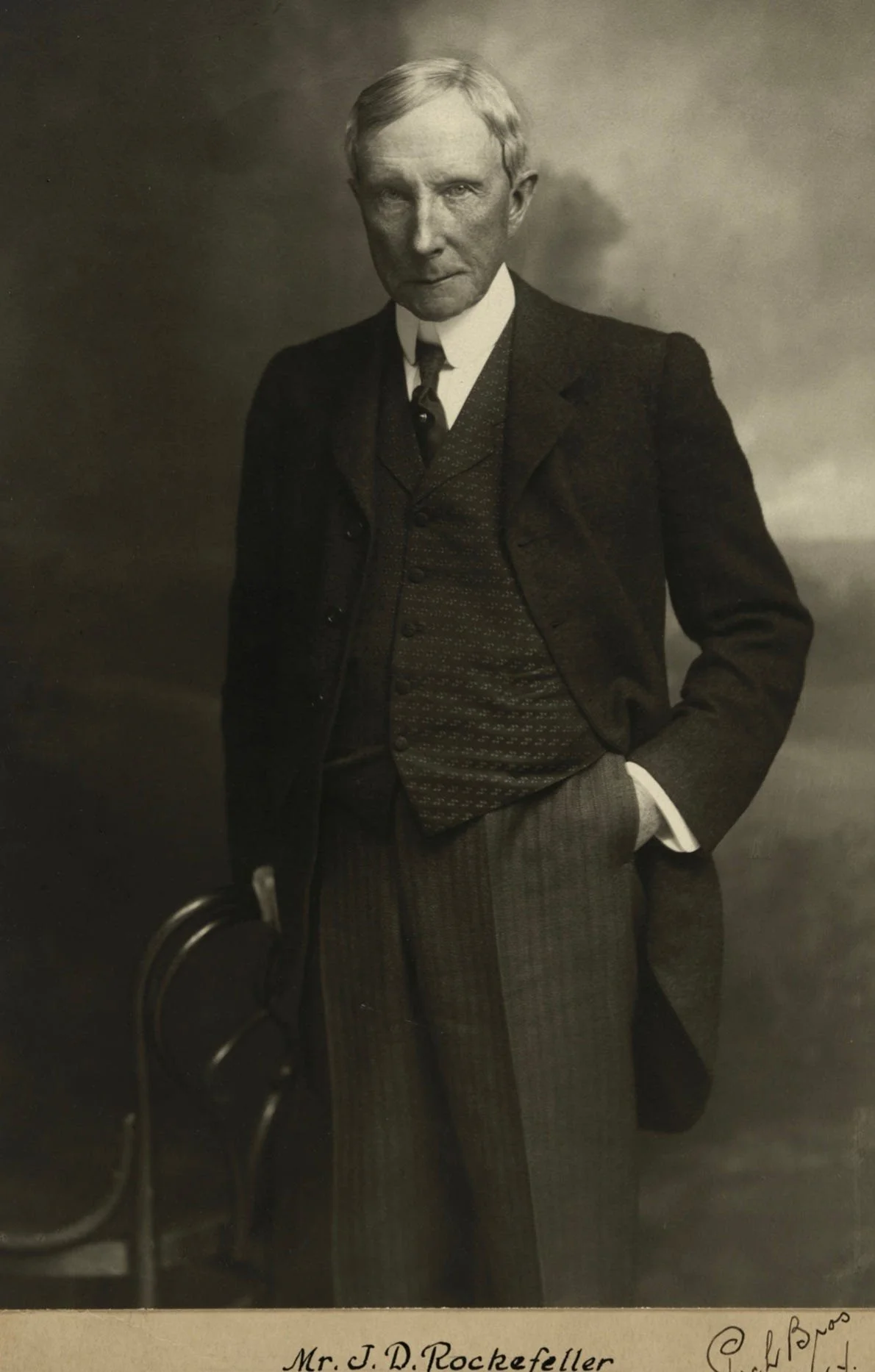
John D. Rockefeller — The Man Who Bent the World's Oil to His Will.
A ghost from the past still lingers in the present. Ever since the Pandemic a rumour has resurfaced as many in the oil industry anticipate the merger between ExxonMobil and Chevron with the subsequent crises and the change in administration in the White House again provoking a debate about it. These conditions could create a single oil company, which could rival Saudi Aramco as the second largest not only in name but also in production capacity, though with its own pros and cons. Nevertheless, still a whisper.
StandardOil: Rockefeller’s Legacy.
A story of more than a century and a half. One of the most influential oil companies in the history of mankind, which played a vital role in the establishment of today’s status quo. And this whole project was mostly in the hands of one man, John. D. Rockefeller, a farm boy from Richford, New York, who grew up in Cleveland, Ohio, in the mid 19th century.
John Davison Rockefeller was born in 1839 and became the co-founder of Standard Oil, the company that came to dominate the U.S. oil market in the late 19th and early 20th century. He was the businessman who turned oil from a messy, regional trade into one of the first great industrial empires of modern capitalism, though also with some luck of growing up in one of America’s most promising oil extraction regions, Ohio. Rockefeller was the man who taught America that “efficiency” becomes less charming once it owns the railroads, the refineries, the prices, and the competitors. Simply put, he pursued vertical integration before business schools made it sound respectable. He entered the oil business in 1863 and, in 1870, he officially incorporated The Standard Oil Company in Ohio along with his brother William, Henry M. Flagler, Samuel Andrews, and Stephen V. Harkness.
He systematically eliminated his competition through horizontal integration, most notably during the "Cleveland Massacre" of 1872, where he acquired 22 of 26 competing refineries in Cleveland within just six weeks. He also negotiated secret rebates and drawbacks with railroad companies, significantly lowering his shipping costs while crippling the ability of his rivals to compete. To bypass state laws prohibiting corporations from owning stock in out-of-state companies, he orchestrated the creation of the Standard Oil Trust in 1882 to centralize his sprawling empire. By the late 1880s and 1890s, Standard Oil was an absolute behemoth, controlling approximately 90% of the petroleum refining capacity in the United States. By the early 1900s, Standard Oil had become the symbol of monopoly power.
Rockefeller was not merely an oil tycoon, but a symbol of capitalism and the far extremes a smart person could go in his ambition and gluttony. What happened in 1911 though, was the wake-up call to the U.S. government and the use of the antitrust law to remind the country what competition in the oil sector meant. The Supreme Court ordered the breakup of Standard Oil. That breakup created several successor companies, 39 to be exact, primarily divided by region and activity with the funny nickname "Baby Standards".
Throughout the mid-20th century, the descendants of Standard Oil became the core of the "Seven Sisters," an elite group of companies that completely dominated global petroleum production. Furthermore, Standard Oil of California partnered with the Kingdom of Saudi Arabia to develop Middle Eastern oil fields; this joint venture eventually evolved into Saudi Aramco.
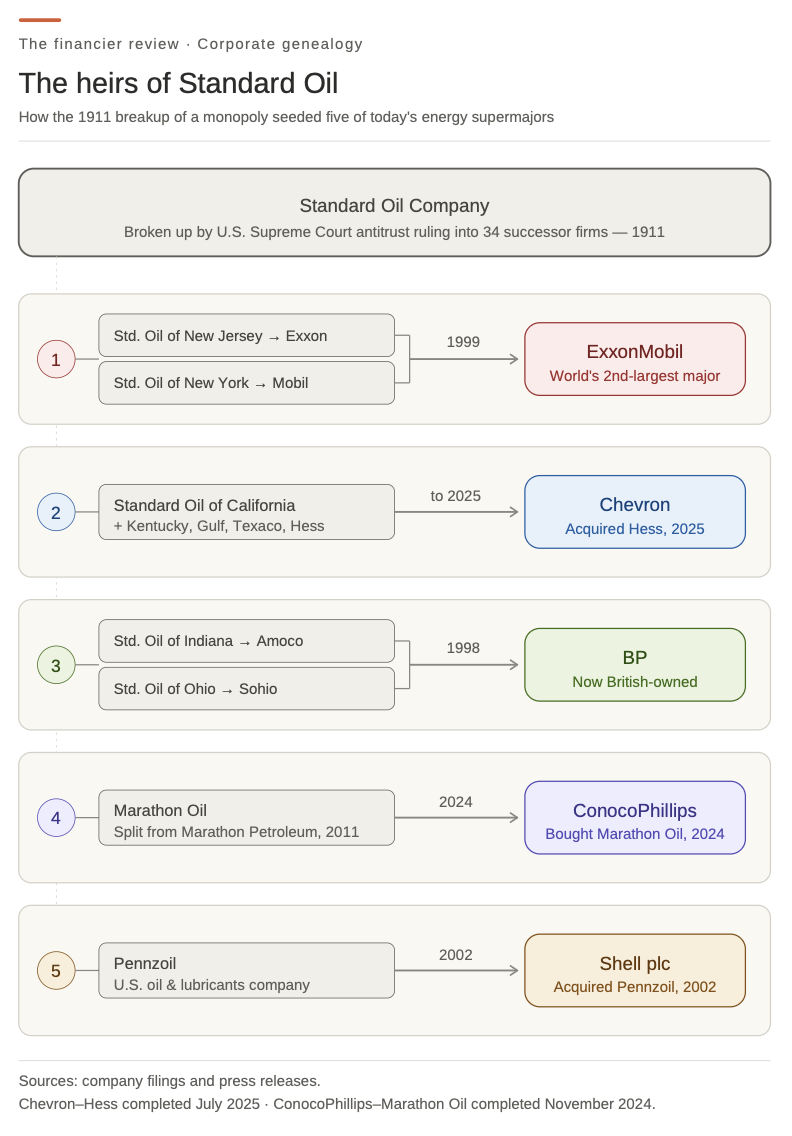
So, while the 1911 breakup created many independent oil heirs, the long-term result was not permanent fragmentation. It was delayed consolidation.
By the eve of the COVID-19 pandemic, the surviving Standard Oil descendants were among the most powerful and valuable corporations on Earth. Protected by powerful balance sheets, ExxonMobil reigned as the largest majority investor-owned oil and gas corporation in the world, employing about 75,000 people at the end of 2019. Chevron stood as the second-largest in the U.S., employing roughly 48,000 people. By 2019, the descendants had done extremely well in one sense: they survived, scaled globally, and remained central to the world energy system. But they were no longer untouchable.
The United States had become a major oil producer again, reshaping global supply and reducing the aura of old integrated oil empires. Despite that, investors, governments, and activists were increasingly questioning whether oil majors were future-proof or merely very profitable dinosaurs. After years of expensive mega-projects, investors wanted cash flow, dividends, buybacks, and restraint, not just heroic stories.
At the turn of the decade, however, the COVID crisis rocked the world.
“OilGreen” Whispers.
The COVID oil crash was not a normal downturn. It was the moment the oil market discovered that even black gold becomes a storage problem when nobody is using it for their normal economic activities. In early 2020, the pandemic did something that wars, sanctions, OPEC disputes, and climate activists had not managed to do with such speed. To drive demand down.
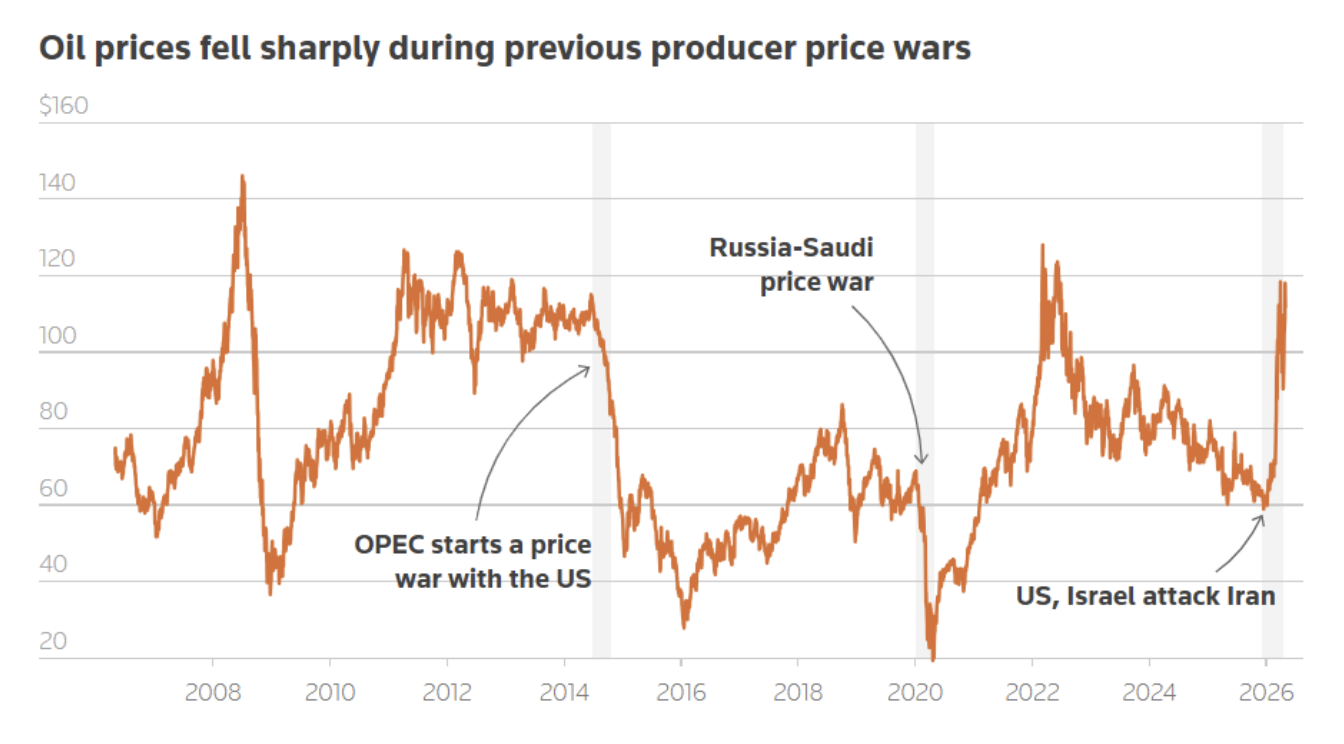
As the virus began severely reducing global demand, most notably in China, OPEC called an emergency summit in March 2020 to propose additional production cuts of 1.5 million barrels per day. However, Russia rejected this proposal, leading to the collapse of the OPEC+ alliance. In response, Saudi Arabia launched a fierce price war on March 8, 2020, slashing its crude prices and significantly increasing production to flood the market. This simultaneous demand destruction and supply surge caused oil prices to immediately free-fall, with global benchmark Brent crude tumbling to a 17-year low.
Because oil production can be slowed down but not stopped completely, the extreme drop in demand created a massive global oversupply. By mid-April, the industry was rapidly running out of physical space to store all the excess oil, particularly at the critical pipeline crossroads. This storage crisis culminated on April 20, 2020, when the price of West Texas Intermediate (WTI) crude oil for May delivery crashed into negative territory for the first time in recorded history, settling at -$37 per barrel. Traders holding oil futures were terrified of being forced to take physical delivery of crude oil they had absolutely no place to store, so they were essentially willing to pay buyers to take the contracts off their hands. Quite messy.
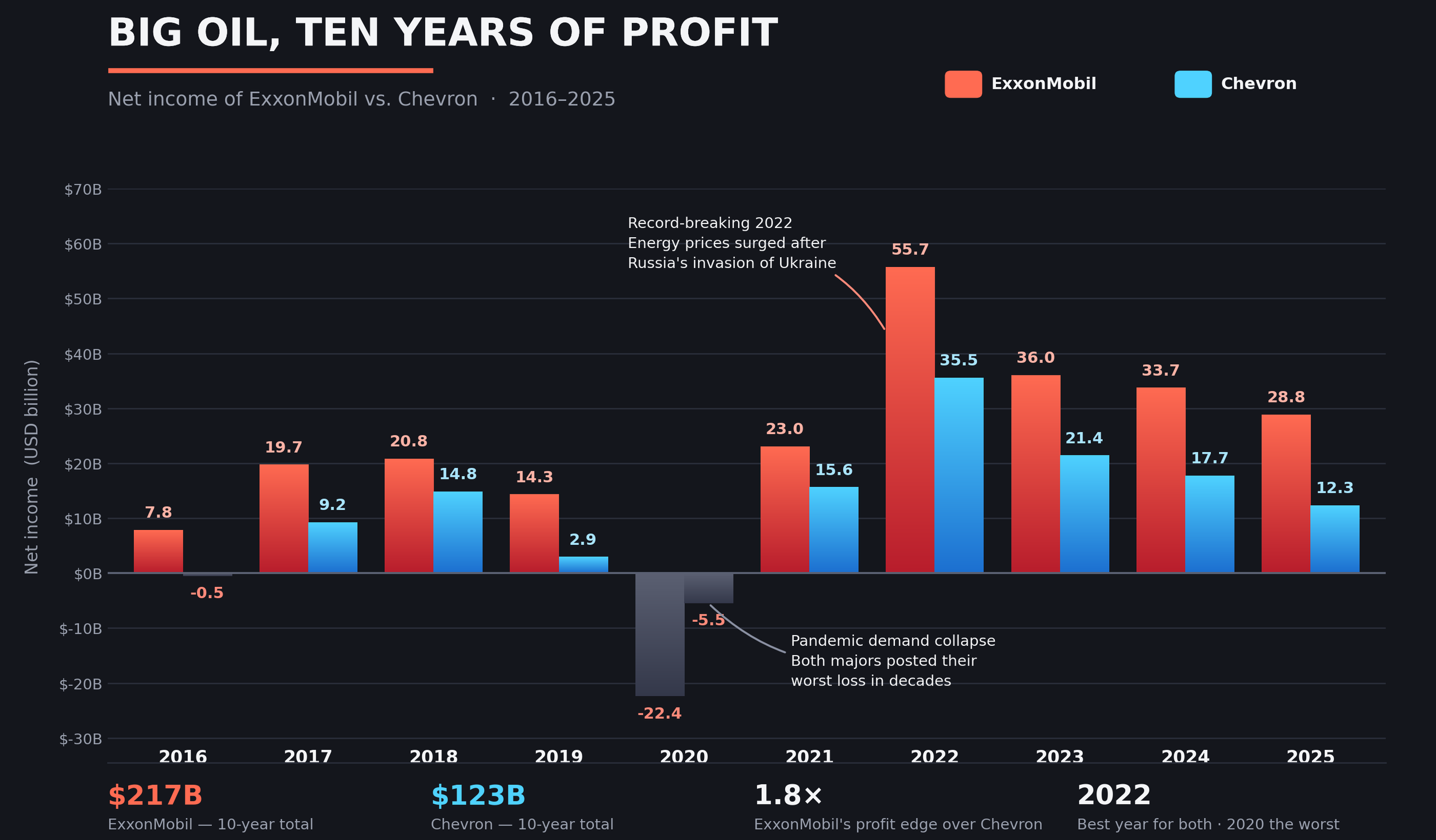
ExxonMobil suffered a monumental $22.4 billion lossin 2020, marking its first annual loss since its 1999 merger with Mobil, with Chevron also recording a loss of $5.5 billion in that year. The crash also exposed a deeper corporate problem. Revenue pressure, asset impairments, lower CAPEX, and investor pressure all made “scale” look attractive again. Thus the whisper about the ExxonMobil-Chevron merger appeared with the reports published in early 2021, that the chief executives of ExxonMobil and Chevron had held preliminary merger discussions in early 2020, after the COVID oil crash. Exxon’s Darren Woods and Chevron’s Mike Wirth discussed combining the two largest U.S. oil producers, in what could have been one of the largest corporate mergers ever attempted.
“But who knows, sometimes the comfort of being with one person fewer on the table is just irreplaceable.”
Russia’s invasion in February 2022 did not only redraw the European security map; it also reminded energy markets that oil and gas are not merely commodities. They are geopolitical instruments with pipelines attached. For Exxon and Chevron, Ukraine strengthened the argument that secure, non-Russian, politically reliable supply had become more valuable. Ironically, “energy security” is one of those phrases that can make almost any barrel look patriotic. Then it was Gaza and the wider conflict in the Middle East, which revived fears regarding the closure of the Strait of Hormuz. At the same time, Venezuela revived its territorial claim over the Essequibo region, a large, resource-rich area administered by Guyana. Fortunately for the oil industry, the 2026 extraction operation of Venezuela’s then leader, Nicolás Maduro, ensured American influence in the country and alleged stability for the oil industry to continue developing the oil-rich Essaquibo region in Western Guyana. On a side note, the conflict between the two countries has persisted ever since colonial times when the British and the Spanish did not demarcate their border properly and after an 1899 international arbitration in favour of Guyana. Currently, Venezuela has threatened to invade Guyana not once. In May 2026 after the final hearings of Guyana and Venezuela’s acting President Delcy Rodriguez it was reiterated by Venezuela that despite Guyana’s probable victory again in the ICJ will not affect Venezuela’s position on the region and that they will continue to see it as their own.
Bomb, Baby, Bomb
“Drill, baby, drill” could be accredited to President Donald Trump’s love for oil and his energy agenda. His lax antitrust policies and his approach towards international organisations, climate policies, and broader rules-based order have been a blessing for most “power structures”, i.e. the oil, finance, and tech complexes, but not always as expected, due to POTUS being POTUS…
To fulfill promises reportedly made during an April 2024 fundraiser at Mar-a-Lago, where he asked oil executives to raise $1 billion for his campaign in exchange for dismantling environmental regulations, upon taking office, Trump immediately signed Executive Order 14154, titled "Unleashing American Energy," to maximize oil and gas development, end drilling restrictions in the Alaskan Arctic, and eliminate EV mandates. He followed this with an order to eliminate "market-distorting" green energy subsidies, terminating tax credits for wind and solar projects.
Despite his pro-oil posture, Trump's aggressive trade policies are actively hurting the American energy sector's bottom line. In June, Trump signed an executive proclamation hiking tariffs on steel and aluminum imports to 50%. This in turn significantly drives up costs for LNG capacity expansion and increases CAPEX for individual firms. Economists warn that these broad tariffs risk slowing down global economic activity, injecting deep uncertainty into the oil market.
The aforementioned conflicts around the world were not the only thing, which has posed a threat to the oil business. Probably the most significant of them all is the current war in Iran, with the Iranians blocking the aforementioned Strait of Hormuz, from where more than 20 million barrels per day usually pass, or around 20% of the worldwide production, and causing average daily shipping flows to decrease by 94%. Despite the ability of a certain amount of barrels to be redirected through other routes, this would account for about 5.8 to 6 million barrels a day, which still creates a 14 million barrel gap between pre-war levels and now. The supply shock meanwhile sent the stocks of both American oil giants plummeting with ExxonMobil and Chevron recording losses of 14.6% and 13.2% respectively in the first 3 weeks of the war in Iran.
The disruption in the Middle East has had immediate and painful consequences for the American economy, though for now mostly muted due to the constant political meddling in the market and trader delusions. The physical shortage of oil has caused spot prices to surge past $140 a barrel at the outbreak of the war, though now it has decreased to meet oil futures prices, contrary to what is expected by economists, value investors, and the general public. Continuing with the bad news, the national average price for a gallon of gas has jumped 28.4% compared to a year ago and inflation ticked up to 3.8%. In a desperate bid to ease the strain on the global market and bring down prices, the US government has announced it will loan 53.3 million barrels of oil from the Strategic Petroleum Reserve.
Source: Reuters
Adding fuel to the fire, the so-called “Petrodollar Agreement” is finally unwinding. This refers to the global dynamic where oil exports are priced in US dollars, generating massive dollar reserves for oil-producing nations. This was codified in a 1974 secret agreement where Saudi Arabia allegedly agreed to "recycle" these petrodollars by purchasing US government bonds in exchange for American security guarantees. However, the system is collapsing largely because major oil exporters like Saudi Arabia are no longer running massive cash surpluses with heavy domestic investment cycles emptying the pockets of Gulf nations in an attempt to escape “Dutch disease”, i.e. the state of economic overdependence on one particular sector. This puts further strain on the U.S. dollar with even further downplay by Iran, which allows only oil tankers through the Strait of Hormuz, whose cargoes were priced in Chinese yuan, an explicit attempt to further destabilize the petrodollar.
The last straw, the UAE leaving OPEC. This could mainly be thanks to 3 other nations - Saudi Arabia, Russia, and the USA. The Saudis have always been a de facto leader in OPEC with their strategy of higher long-term prices with a lower global output rate clashing with the UAE’s national interest and spare capacity, which now will be more significant than ever due to the Iran war and the damage done to other Gulf energy facilities. Furthermore, the Emirates have long wanted to “stick it” to the Saudis for their OPEC dominance as well as for all of the recent geopolitical "hiccups", which have led Saudi Arabia and the UAE to be at odds with each other - starting from Sudan and Somalia to Yemen and Israel, not to even mention Pakistan and India. Continuing with Russia, increasing UAE supply and lowering prices could act as a punishment due to them sabotaging OPEC+ in 2020, when they disagreed to cut production. Lastly, the USA and their agreement with the UAE for a financial “Swap Line” in order for the Emirates to exchange foreign currency for dollars at a fixed exchange rate in order to stabilise their economy. The last bit was likely conditional on the UAE leaving OPEC as both the USA and Israel generally want lower global oil prices due to inflationary pressure.
In short, the oil market is a mess right now. The Gulf crisis turned spare capacity into rumour and OPEC discipline into theatre. Oil prices rose not because the world forgot how to produce oil, but because the world remembered that producing oil and delivering oil are different businesses. In that world, the Iran war adds fuel to the argument but also smokes to the room regarding a merger between ExxonMobil and Chevron. It strengthens the case for scale, strategic reserve depth, and geopolitical soft power. At the same time, it makes regulators and politicians more alert to the danger of giving two already powerful oil companies even more influence over an inflation-sensitive commodity.
At the end of the day, it is widely understood that this administration does not focus on antitrust measures but more on geopolitical strongman performances against a backdrop of personal enrichment at the expense of ordinary people. When taking this into account, it has to again be discussed what the current dynamics and relations between the two American giants are.
The “Hess” Case
Hess Corporation. A relatively unknown corporation with a minority stake at the Stabroek Block, a massive offshore oil field off the coast of Guyana. Its ownership structure is ExxonMobil with 45%, Hess with 30% and CNOOC with 25%. That 30% Hess stake is what made the deal move forward. Not because Hess was suddenly the world’s most exciting company, but because it owned a large minority position in one of the most attractive oil provinces discovered in recent decades. The Stabroek Block has been reported to hold more than 11 billion barrels of recoverable resources, making it one of the fastest-growing offshore production regions in the world.
For ExxonMobil, Guyana was already central. In an industry where mature assets decline, climate politics complicate new exploration, and investors punish wasteful CAPEX, Guyana offered a moment of relief for oil companies and everyone wanted in on the deal. That explains the strategic tension. Exxon was not trying to block Chevron because it had suddenly discovered a passion for legal theory. Exxon knew that if Chevron acquired Hess, Chevron would become Exxon’s partner inside one of Exxon’s most valuable growth factors.
In October 2023, Chevron announced a $53 billion acquisition of Hess Corporation. The acquisition of Hess offered Hess’s Guyana stake, its assets in the U.S. Bakken shale region, and a cleaner long-term production-growth story. The problem with ExxonMobil was the former. Exxon and CNOOC have argued that they had contractual rights connected to Hess’s 30% stake. They claimed that the Chevron-Hess transaction triggered rights of first refusal or pre-emption under the Stabroek joint operating agreement. Chevron and Hess argued the opposite, that this was no sale of the stake itself but rather of the whole company. This was the moment when the two competitors went head-to-head in an arbitration challenge initiated by ExxonMobil to block the acquisition, claiming it had a right of first refusal on Hess's Guyana assets. Simultaneously, the merger faced regulatory hurdles in the U.S. In September 2024, the Biden Administration's Federal Trade Commission (FTC) issued a consent order prohibiting Hess CEO John Hess from joining Chevron’s board of directors.
The result was a delay. Chevron had originally expected the deal to close earlier, but the arbitration pushed completion back until July 2025, when the ICC (International Chamber of Commerce) tribunal ruled against ExxonMobil and CNOOC, allowing Chevron to complete the Hess acquisition. Additionally, the newly appointed Trump Administration's FTC overturned the previous ban, clearing the way for John Hess to join Chevron’s board. While Chevron ultimately won the case and finalized the acquisition, the arbitration delayed the deal by over a year and cost Chevron billions. At the end of the day, the merger proved its worth.
Exploration is risky. Acquisition is expensive. Executives usually prefer expensive, because at least the banker can make a slide deck for it.
StandardOil’s “Little Urchin”
After an extensive explanation of the prerequisites of such a merger and the precarious geopolitical situation oil markets are currently in, we will take a look at the scenario of the two oil giants merging.
At current market values, the hypothetical entity would sit around $1.05 trillion in combined equity market capitalization, roughly $665 billion for ExxonMobil and $389 billion for Chevron as of the latest available market data, which would make it the 9th largest company in the world just ahead of Samsung, with its current $1.02 trillion valuation. This does not even include the synergy-ramp premium. The corporate story would be about scale, geopolitical relevance, and pure late-stage capitalism efficiency. The less polished one would likely revolve around fewer competitors, larger reserves, and pressure against the competition.
A combined Exxon-Chevron would be valued less like a normal industrial company and more like a cash-generating machine for production. A combined Exxon-Chevron would likely produce around 8 to 9 million barrels of oil equivalent per day if we add ExxonMobil’s roughly 5.0 millionboe/d Q4 2025 production and Chevron’s roughly 3.7 million boe/d post-Hess production, which would even exceed the UAE’s production capacity.
ExxonMobil remains the heavier weight. For full-year 2025, Exxon reported $28.8 billion in earnings and $52.0 billion in cash flow from operations. Chevron, after absorbing Hess, reported $33.9 billion in cash flow from operations together with $12.3 billion in earnings. Unfortunately, a downward trend could be seen across both companies with them recording a contraction in net income earnings from Q4 2024 to Q4 2025 of -14.5% and -30.3% for ExxonMobil and Chevron respectively. On a rough pro forma basis, that gives the merged company about $85.9 billion in annual operating cash flow before any synergies, disposals, debt write-offs, and management’s overenthusiastic stance.
Source: The Financier Review
Exxon brings scale, Permian strength and Guyana exposure through operational capacity. Chevron brings another major upstream portfolio, the Hess-Guyana stake, LNG and Kazakhstan exposure, while being often viewed as the more fiscally prudent of the two giants. Regarding Capital Expenditures (CAPEX), the primary driver for such a megamerger is achieving extreme cost-cutting and operational efficiencies to survive volatile markets. Analysts have estimated that a merger would allow the two giants to slash a combined $10 billion in annual capital expenditures. Furthermore, they could potentially cut $15 billion in administrative expenses, allowing the new supermajor to drastically lower its break-even costs, which is of immense importance due to the more expensive refining of crude oil in the USA in comparison to the Gulf, as well as to secure the giant’s position in lower-priced oil scenarios in the future. In the end it would be expected to have a combined annual CAPEX envelope somewhere around $45–50 billion before restructuring begins.
ExxonMobil’s latest available figures show total debt around $47.7 billion and quarterly EBITDA around $15.9 billion for Q4 2025. Chevron ended 2025 with $40.8 billion of total debt, $34.5 billion of net debt. The total debt of the combined entity will be around $88 billion with a Debt-to-EBITDA ratio of around 0.9x, signaling a structurally stable company. This is without accounting for the costs of whichever company, in this case likely ExxonMobil, acquires the other, which will significantly drive up this metric. Nevertheless, the Net Debt-to-CFFO (Cash Flow from Operations) metrics of ExxonMobil and Chevronare around 0.75x and 1.0x respectively, which indicates an incredibly strong liquidity management for both of the companies as they are cash-making machines. This indicates that even if they merge, they will be in a far better position to afford repayments of their combined total debt. By pooling their free cash flow, the merged company would have unprecedented cash flow leverage to dominate public markets, fund massive share buybacks, and protect its dividend against activist investors, as both companies possess a 38-year plus dividend growth streak. It should still be mentioned that the earnings of these companies are volatile due to the nature of the oil market and everything could change with the price of oil.
Free float adds another layer. Both ExxonMobil and Chevron are widely held public companies, with large institutional ownership through index funds, pension funds, asset managers, etc. A merged company would become an even larger component of major indices, likely increasing passive ownership and liquidity.
The merged behemoth would further be a synergy monster. Both companies operate across similar parts of the oil-and-gas value chain, including upstream exploration and production, LNG, refining, and many other areas. They were the same company 115 years ago, nevertheless. The merger will not just be any merger but the consolidation of the two biggest American competitors, which were “divorced” in 1911 against their own will. Apart from antitrust issues, this will illustrate horizontal integration in its cleanest form. Further structural synergies are the sharing of technology and data, which will be followed by corporate restructuring and process integrations.
Cost synergies would include the aforementioned enormous 10 to 15 billion CAPEX decline as well as management duplications, which will be cut, with the last bit being the financing advantage forcing a lower cost of capital through scale, stronger cash flows, and better bargaining power. Moreover, the revenue synergies would further contribute to the increased performance of the giant. Procurement power amongst goods and service providers, upstream portfolio optimisation through combining the different oil fields in one capital-allocation structure, as well as the increased refining efficiency through the rationalisation of assets, logistics, distribution etc - these are all factors, which will further assist the company during its market consolidation.
However, the financing of such a major takeover would require immense capital commitments from various investors. But who would be up for such a commitment with antitrust experts peeking over the window?
OilMoney… but for Whom?
The primary beneficiaries of this consolidation would be executives and shareholders. With researchers’ predictions regarding the combined $15 billion in cuts to administrative expenses outside the CAPEX savings, would impact the workforce. Though not as significant, nor likely, this consolidation in the domestic oil industry could force a race to zero with oil prices historically being lower with higher production costs within the American shale industry. At this point these are just speculations.
Financially, a “megamerger” of this scale would likely be executed through a massive all-stock transaction, similar to how Chevron absorbed Hess by issuing approximately 301 million shares of common stock. By leveraging their enormous market capitalizations, the new entity would wield unparalleled free cash flow to fund shareholder dividends and massive stock buybacks to offset the cost of such an enormous transaction. The current situation with high share liquidity, dividend-driven mechanics, and huge free cashflow generation would mean that most of the financing will come from the public market with new shareholders experiencing solid returns due to the integration potential of the “unwanted divorce”.

“Chevron bets on green hydrogen”
The governance and restructuring of a combined Exxon-Chevron would require integrating overlapping global assets, but it would also consolidate immense corporate power into a single boardroom. Unlike Saudi Aramco, for instance, where the company is majority state-owned, the Exxon-Chevron merger would allow the oil lobby to become increasingly influential in American elite circles with them having the ability to push their agenda significantly easier at the expense of renewable energy expansions. A preview of this occurred when the Trump-appointed Federal Trade Commission (FTC) recently overturned a Biden-era ban, officially allowing former Hess CEO John Hess to join Chevron’s board of directors, as previously mentioned.
Unfortunately for the oil giant, it would face severe political and macroeconomic risks. For example, Donald Trump’s executive proclamation hiking tariffs on steel and aluminum imports to 50% is actively hurting the oil sector's bottom line. Oilfield services executives, such as Baker Hughes CEO Lorenzo Simonelli, have warned that these tariffs add up to $200 million in costs for individual companies, significantly driving up the price of oil country tubular goods (OCTG) and liquefied natural gas projects. The entity would further be heavily exposed to global conflicts. Moreover, the Guyana Stabroek Block remains under the shadow of a centuries-old border dispute with Venezuela, which has vowed, even after the change in leadership, to ignore the upcoming International Court of Justice ruling regarding its annexation claims.
Lastly, the recurring claim that Donald Trump’s return to the White House has brought a wave of consolidations and has paved the way for mega mergers, could be supported for example by the aggregation of the “No Kings” movement with further outrage during the high-stakes dinner between the Ellison family, Trump and co. A clear signal that the regulator has to be further scrutinised by the public as regulatory independence comes increasingly under strain due to the political meddling in antitrust affairs. Nevertheless, on the antitrust front, the Trump administration has been highly unpredictable. Surprisingly, Trump’s FTC Chair, Andrew Ferguson, and former DOJ Antitrust head, Gail Slater, chose to retain the strict Biden-era 2023 Merger Guidelines, which view mergers between highly concentrated large firms as inherently suspect.
How did we get here? Really…
Prior to the current administration, there was a massive global push to transition away from fossil fuels to combat the climate crisis. The Biden administration passed the 2022 Inflation Reduction Act (IRA), the largest package of domestic climate measures in U.S. history, which poured billions into clean energy, electric vehicles, and low-carbon manufacturing to help halve US emissions by 2030.
However, major oil companies like Exxon and Chevron largely resisted pivoting to renewables, choosing instead to double down on oil and gas by arguing that fossil fuels will remain essential for decades. Facing the long-term threat of a green transition and the short-term volatility of market crashes (like the 2020 COVID-19 demand crash), these companies pursued aggressive mega-mergers to cut costs, consolidate power, and survive the shift.
President Donald Trump’s return to the White House has dramatically reversed the nation's green trajectory, driven heavily by his deep ties to the fossil fuel lobby. In an explicit demonstration of this relationship, Trump reportedly hosted a fundraiser at his Mar-a-Lago club where he asked oil executives to raise $1 billion for his campaign. In exchange, he promised a "deal" to roll back environmental regulations, hasten permits, and end restrictions on drilling.
The modern consolidation of the oil industry echoes the Gilded Age, bringing the importance of antitrust laws back into the spotlight. From 1911 to 2020 and beyond into the current Trump-led era of modern American politics and geopolitics. Despite keeping strict merger guidelines on paper, Trump's Federal Trade Commission (FTC) and Department of Justice (DOJ) have been accused of regulatory meddling. By allowing massive combinations to proceed unchecked and dropping major price-fixing lawsuits, the current administration has cleared the path for a new era of corporate oligarchy, leaving consumers vulnerable against the corporate power of multi-trillion dollar giants. But…
Reality check: This deal is not happening. All of the trails leading to this conclusion are not going away, though the environment for both corporations is currently favourable enough to delay this question.
Conclusion: Conditions Shape Decisions.
People and corporations more often make decisions during bad times rather than during good times. This is because people are risk averse and once they are part of the status quo, they will always want to retain their wealth by delaying risky decisions and actions, possibly by entrusting them to someone later down the line to have to make the tough calls. This is why crises force change and why the biggest winners and losers come out simultaneously after wealth redistribution.
The legacy of John D. Rockefeller still lives on and continues to shape the oil market in the USA and beyond. ExxonMobil and Chevron have always been closely aligned despite the fact that they are competitors. Their rivalry also brought them to the table, when both CEOs met to discuss preliminary merger discussions. Despite failing to materialise and the market conditions then easing with new oil discoveries in Guyana lighting up a feud between the two giants, the overall trajectory and cashflow generation have kept pace with people’s expectations for the better part of the last decade.
When the market conditions eased after 2020, the looming issue of changing the status quo was already not as severe, which galvanised both companies to consolidate their share separately by acquiring smaller competitors. This change in course then diverged and enabled them to become “unfavourable” partners in Guyana, as well as to coexist in a post-Biden mega-merger environment. Despite all of that no one knows what the current geopolitical situation will bring us and how the antitrust regulations might change or, in fact, remain unchanged while operating more in the grey area.
Well, after this much oil business, even Rockefeller might be tempted to come back from “retirement” to check on how the family estate is managed…

All data used in this article is derived from publicly available institutional reports and industry analyses.
This article is for informational purposes only and does not constitute investment advice, political affiliations or other types of non-verbal support or aquisations.
Spas Arsov
Financial Analyst, M&A Specialist.
The Financier Review
© 2026 The Financier Review. All rights reserved.