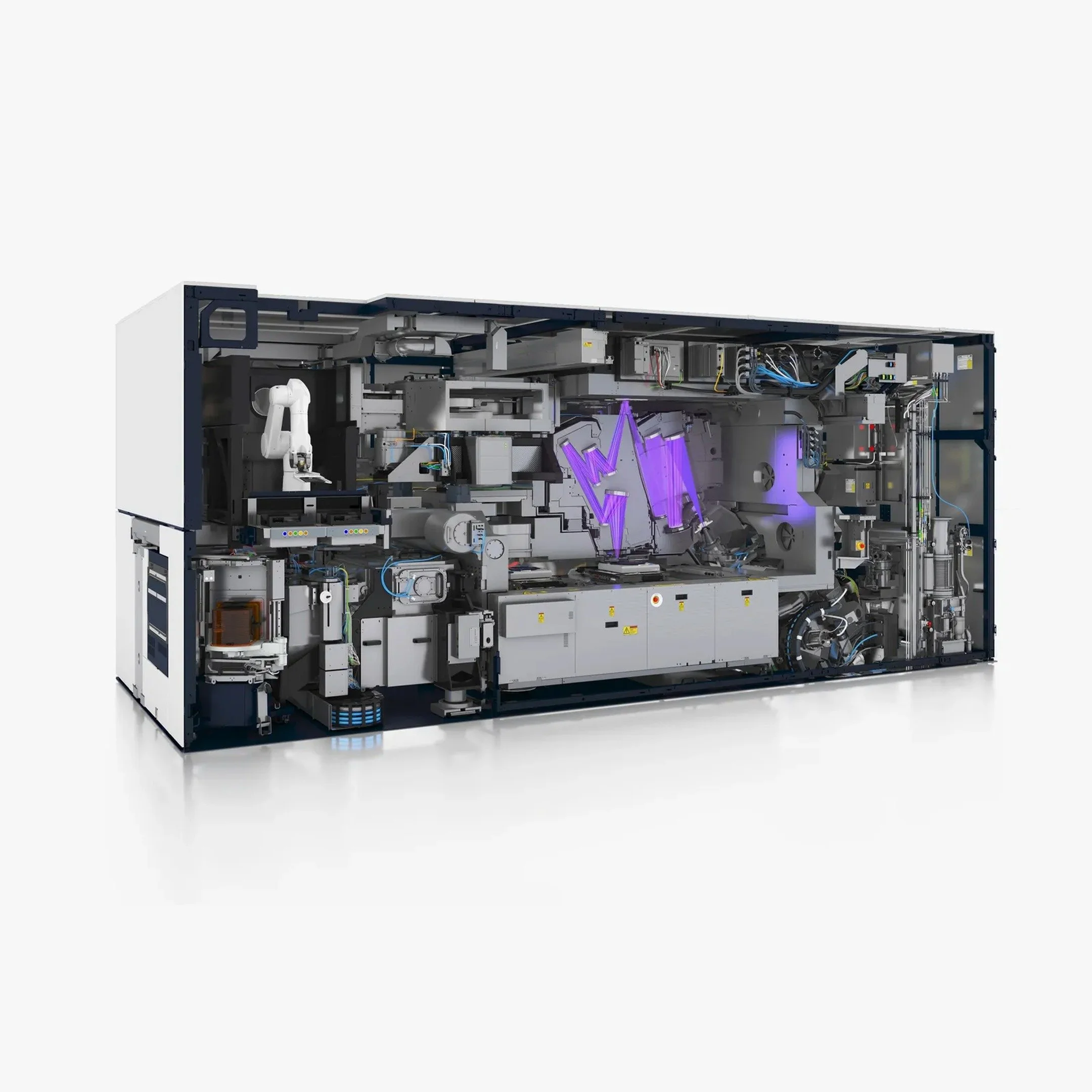
ASML is a company that not many people have heard of, but in reality it sits behind almost every advanced chip in the world. But this Netherlands-based tech giant doesn't make chips at all. It developed and manufactures the machines that make those chips.
ASML's machines are the only ones that use extreme ultraviolet (EUV) lithography systems to print the finest circuit patterns onto silicon. Without them, every cutting-edge chip from companies like TSMC, Samsung and Intel cannot be produced. These companies are also part of the reason that ASML could manufacture these machines, as a whole. The R&D process of such a complex system is very time-consuming and expensive, with ASML investing more than $9 billion over two decades in research and development to bring their idea to life. But by 2012, the development costs for the EUV were becoming so large that ASML alone couldn't keep up. But then a rescue mission was launched, materialized in a move never seen before in tech history, ASML's top customers - Intel, TSMC, and Samsung - actually funded the machine's development by collectively pouring around $6 billion directly into ASML to keep the EUV research program alive.
Additionally, some of the biggest tech names such as Nvidia, Apple and AMD, despite only designing their chips and relying on manufacturers like TSMC and Samsung for their ideas to become physical products, also rely on the foundation of ASML. In practical terms, this puts ASML's output in a position which sets the ceiling on how fast the AI buildout can scale.
But what makes this company so unusual is that it has no real rival. It holds 100% of the EUV market, and its new and improved High-NA (High Numerical Aperture) EUV machine costs around $400 million each. As a result, these factors put ASML in a very unique position. Because there are no other competitors in a market with exceedingly high demand, ASML can price these machines at a significant premium, forcing manufacturers to buy without an alternative.
The latest financial results demonstrate what this dominant position is worth. In Q3 2026, ASML reported net sales of €11.662 billion, which was a growth of roughly 55%, compared to €7.516 billion the previous year. Additionally, gross margins came to around 57.5%. ASML expects €44-45 billion in sales this year. Combined with its growing margins, it strongly displays the dominant position this giant holds that customers have little choice but to pay up.
The real question is how long this run can last, especially with two challenges looming on the horizon. With China having a state-backed effort to build its own DUV (Deep Ultraviolet) machines, which threatens the less advanced end of ASML's business. Additionally, the new generation of machines - High-NA, where the speed of customer adoption will test and shape the company's next stage of growth.
When we talk about the AI chip industry it is giants, such as Nvidia who get most of the headlines. But when we pull the curtains, behind the scenes, Nvidia buys from TSMC, and TSMC has to buy the lithography machines that prints the chips from an address in Veldhoven. In Q3 2026, that same address reported €11.66 billion in sales, with an enormous 57.5% gross margin and a net income of €4.96 billion, an increase of 134% in a year.
Without a question, ASML's third fiscal quarter is a clear statement as to what happens when the demand for lithography machines in a monopoly, outruns the capacity to produce. The financials also support this narrative as the Dutch company generated their enormous income from 113 new lithography systems, up from 86 units in Q2, and all machines were priced into a market where there is no alternative.
In this story the profit margin certainly tells us more about the industry than net sales. Their gross margin reached 57.5%, an increase of 3.5% since the previous quarter, and +5.9 compared to last year. An increase in profit margin, of this scale, is rarely observed in the equipment manufacturing sector. But it is a byproduct of what a company achieves when it sets the price. For operating margins, the widening was even more significant, from 32.8% to 44.4% this quarter. Why? Well, because sales expanded massively while R&D rose by less than 6% against 55% sales growth.
Further, it is important to mention that we have to make two clarifications to the headline figure for ASML. First, about €510 million of this quarter's net income is thanks to the fair-value gains in ASML's stake in Mistral AI, not from producing sales. When we deduct this from their net income we land closer to €4.5 billion - more than double compared to last year. Secondly, the reason for the inflation of margins is partly cyclical. Management credited a richer tool mix and productivity upgrades, and both can soften once customers finish their current ramps.
But what we want to discuss next is a metric that is rarely regarded to when looking at ASML. That number is Installed Base Management (I.B.M). IBM is the systematic tracking and maintenance of products or equipment after they have been sold and deployed to customers, helping companies maximize service revenue and optimize asset performance. ASML's IBM number sits at €3.29 billion, up from €2.76billion in Q2. And this revenue is very steady as it does not rely on new sales, every machine that ASML has ever shipped keeps on returning capital gains through: service contracts, field upgrades that raise throughput on highly specialized tools, that only they can replace. At 28% of total sales, the installed base is the annuity beneath the cycle we argued for, and the reason that a CAPEX pause at one customer hurts ASML much less that it would hurt a company that just sells new machines.
And the cash they earned followed, AMSL repurchased €4.1 billion of its own shares in Q3 and ended with €12.7 billion in cash and short-term investments. An increase from €7.6 billion in Q2. ASML's monopoly isn't just managing scarcity. When it returns capital at this rate, while demand has outrun planned capacity until 2028, they are monetizing rather than managing.
ASML now expects Q4 sales in the range of €14.2 billion - €15.2 billion with a gross margin of 57% and full year 2026 sales at €44-45 billion. Both figures are record and are higher than what the company promised last quarter. But what we can scrutinize them for is whether they can deliver on the high expectations they have set - can a business already selling €11.7 billion a quarter have a plan on how to grow an additional 25% in the next one.
So, the first three quarters in 2026 brought €29.8 billion. To hit the full year target that ASML gave last year Q4 has to deliver in the range €14.2 to €15.2 billion, which is 22 to 30 percent more than the third. But the issue is that Q3 already is up 25% above Q2. Even if ASML lands in the bottom of our estimated range, one quarter will equal half 2024's entire sales. Through projections, this year comes out 35-38% above 2025 and 58% above 2024. In July the guidance floor was €43 billion and ASML raised it three times in a row.
But from a structural perspective, orders aren't the concern for AMSL's future growth, their factory output is. ASML will build at least 60 low-NA EUV systems this year and about 80 units next year. The company's team has committed to a 30% increase in capacity for low-NA EUV and immersion DUV in 2027, and is further exploring another 30% for 2028. Management claims that demand already exceeds all of that and customers are not waiting for ASML to find buyers, but quite the opposite, they are waiting for ASML to find slots.

ASML guided the Q4 gross margin at 57%, half a point below the Q3, even though sales are set to rise again. And the reason for this are costs, not the price. ASML is spending to add capacity before that capacity ships anything, and it has budgeted €1.2 billion of R&D for the quarter alone.
With all that we have identified two risks regarding ASML. The guide that they have proposed for the increase in revenue is highly unforgiving. A slip of just five systems from December to January is a billions euros off the year, which could cause significant investor uncertainty. Also, the pricing upside is not in numbers yet, ASML has said value-based pricing, charging customers for the output a machine delivers rather than for the machine, contributes almost nothing in 2026, 2027 and all of 2028. So the market is paying for a climb that management has not finished materializing yet.
EUV technology took roughly three decades to go from lab research to printing chips in high volume. For much of the development, it looked like it might not even work. Generating the light alone means hitting microscopic droplets of molten tin with a laser about 50,000 times a second, turning each one into a plasma that emits the light. The light is then bounced off mirrors polished to near-atomic smoothness, inside a vacuum, because the wavelength is absorbed by almost everything, including air. No company starting today could simply copy that: the tacit knowledge is held by thousands of engineers and built on years of failed prototypes.
Additionally, ASML has not worked alone. The mirrors and optics are produced by Zeiss in Germany, and the lasers behind the light source come from Trumpf, also in Germany. Both are specialists with no equivalent in EUV. As mentioned above, Intel, TSMC and Samsung also invested around $6 billion in ASML to help fund the development of EUV, which ties the three biggest chipmakers to ASML's success and gives them a motive to keep it ahead should a direct competitor arise.
What's more, with the surge in AI development, demand for EUV machines continues to increase, as the most advanced processors, which power modern data centres, rely entirely on these systems. Further, the second critical driver in the AI race is memory manufacturing, and in this segment, the producers of DRAM and high-bandwidth memory (HBM) - the memory that operates alongside AI chips - are also starting to progressively move to EUV. That shift is occurring because EUV technology allows memory manufacturers to bypass multi-patterning, which is a technique that needs several masks to print a single layer, which significantly raises production cost and complexity. An example of this is Samsung, which has disclosed that it plans to integrate High-NA EUV into its high-volume DRAM manufacturing by 2028.
Nevertheless, it's worth being precise about where the monopoly lies. While ASML has essentially 100% of the EUV market, when it comes to the older deep ultraviolet (DUV) technology, the situation is different. There, ASML still has the lead in the market; however, it faces competition from Nikon and Canon, alongside emerging Chinese challengers. Though the three firms operate in the same industry, they cover different needs, and this is exactly where the advantage of ASML lies. Because almost all modern gigafabs run on ASML scanners, it makes it easier for engineers to align layers between an ASML DUV machine and an ASML EUV machine. ASML's advanced data logging software makes analysing overlay errors seamless across an entire fleet of machines. Comparatively, Nikon's price undercuts ASML's by 20-30%, as a strategic move to try to capture a part of the market, but if a fabricator tries to align a circuit layer printed on a Nikon tool back to a layer printed on an ASML tool, there is a high chance of alignment errors. Because even fractions of a nanometer off-alignment can cause billions of dollars in yield loss, chipmakers frequently stick with ASML. In response, Nikon has heavily focused its latest scanner platform developments around cross-compatibility software that allows their tools to cleanly match and align with existing ASML fleets. Canon operates in a completely different part of the market. It builds highly reliable and incredibly fast machines designed to print foundational layers. Because power semiconductors, used for electric vehicles, IoT sensors, and analogue chips do not require the sub-10nm precision, Canon provides massive volume to suppliers who need cheap, high-output manufacturing.
Put simply, ASML holds a strong lead in the high-end DUV, which integrates seamlessly with its exclusive EUV fleet, while Canon and Nikon focus on highly cost-efficient, high-volume systems for mature, foundational layers and specialised advanced packaging.
ASML's strongest competitive advantage is that it leads in developing cutting-edge systems, and the next step is a machine called High-NA EUV. It allows printing finer detail than today's EUV tools, but comes with a hefty price tag of around $400 million each. It is also where ASML's growth story meets one of its biggest challenges, as the biggest names in the industry are still unsure whether it is worth paying this price yet.
Intel was the pioneer in adopting this new technology, as it was the first to install a High-NA tool to produce its next-generation chip, called 14A (1.4nm). Intel has reportedly started by using the machine on a node that would work without it, so that its engineers can learn the process before 14A makes it a necessity. Following this, Intel has also reportedly said that yields on its Low-NA and High-NA flows have reached parity. This gives ASML a customer that can give it a working reference, which would lower the concerns about the technical risks of adopting this new technology for other customers.
On the other hand, TSMC is far more cautious. It has said publicly that it will not use High-NA for its comparable A14 node, and a report puts its plans for High-NA around 2030. That matters, because being the largest EUV customer, TSMC can set the pace for the rest of the industry. But if TSMC can keep extracting value from their existing EUV machines by printing some layers in several passes, it puts the decision for High-NA on cost efficiency, and not just capability. That puts ASML in an uncomfortable position, where its competitor is its own earlier product.
Nevertheless, this delay in adoption shouldn't be interpreted as a loss, as TSMC will almost certainly continue buying standard EUV products, which means the effect is based on timing. ASML's own capacity to produce the new system is also still limited, as it reportedly can build fewer than 20 High-NA systems a year, with a backlog that runs through 2027. For now, demand is not the problem. Memory production could also soften the risk, with Samsung planning to introduce High-NA into DRAM production by 2028.
The danger in this situation is the expectations, as ASML's next wave of growth depends on a handful of customers who are moving at very different speeds. Moreover, a bigger delay at the larger customers, pushing that expected growth back even more, might affect the confidence in investors. But for now, High-NA is a positive next step, and not something that current results depend on, which should keep investors calm for the near future.
For years, a big concern for ASML has been what would happen if China starts building its own machines.
In July 2026, Reuters reported that China had begun producing its own immersion DUV lithography tools. According to a source, that is familiar with the matter, a little-known state-owned company, Shanghai Aishengna, is leading the movement after collecting teams from some of the best Chinese lithography startups. Those teams reportedly include Yuliangsheng (an affiliate of Huawei-backed SiCarrier) and SMEE (China's oldest lithography maker). The first machines are expected to go to domestic chipmakers such as SMIC, Hua Hong and CXMT. The consequences of this showed immediately, as ASML's shares dropped by 6-8% in a single day, depending on the platform.
The push that started this came from the US restricting China from buying ASML's most advanced EUV systems, and Dutch export controls restricting access to some advanced DUV machines. This forced China to turn towards developing domestic tools as a hedge against potential Western governments tightening restrictions on exports or servicing.
For now, Chinese output is reportedly about five machines this year and is expected to be around 20 in 2027, which would equal roughly 3.8% of ASML's targeted 2026 immersion-DUV capacity of about 130 systems. Despite everything, the technology looks like it is still behind that of ASML. The Yuliangsheng machine being tested at SMIC reportedly resembles a model of ASML from 2008 - the Twinscan NXT:1950i - and SMIC's 28nm tool uses the more expensive multi-patterning process to reach 7nm-generation chips. Meanwhile, China's EUV effort is still at the prototype stage.
The more immediate risk may lie in ASML's own current sales. China's share of machine shipments rose from 14% to 23% in the third quarter, as memory makers stockpiled tools, rounding the share to 20% for the year. While that surge in sales is good for today, it could also mean customers are trying to buy ahead of tighter rules or if a domestic alternative appears, which would leave less demand to come for the following years.
This leaves the conclusion that the danger is real, but that it will appear gradually. China is still far from matching ASML at the leading edge of technological precision and quality, but it is slowly building towards improving and aiming at the part of the business where competition already exists, which could lead to ASML losing a bigger part of the DUV market.
at the guide
Even though ASML has no competitors, they still have a share price, and that share price can fall. ASML's has fallen recently: the stock is down 8.5% in a month, but still up 41% for the year. Right now the company is worth €620 billion, 61x last year's earnings and 39x what the 2026 guide holds. In the month of July, with the stock trailing at its highest valuation, analysts were debating whether ASML would become the first European company worth a trillion dollars. Well, it needs another 40% to get there.
What the premium pays for are two things: the monopoly that ASML holds on the market, and the belief that the AI CAPEX will continue to grow. Both carry a high risk which the numbers do not show.
The first one is concentration, as of now five customers buy almost everything ASML makes: TSMC, Samsung, Intel, SK Hynix and Micron. TSMC is believed to hold more than half of the installed EUV base. If one of them delays a purchase, ASML's quarter moves and nothing that ASML does can bring the order in time. And this isn't just a hypothetical scenario, in 2024, with the demand for everything except AI chips being flat, ASML's sales grew by less than 3%, to €28.3 billion from €27.6 billion. The company didn't lose a single customer, they simply stopped buying for a year.
Another very significant future risk for ASML is China. The Eastern competitors have actually managed to move the stock. When a report came out in late July that a state-backed Chinese maker had begun limited serial production of similar immersion DUV tools, the shares fell 8.5% in a single day, and by the end of the month the stock was 21% below its June peak. What is even more alarming is that the numbers the Chinese quoted were rather small, 5 units this year and perhaps 20 next year. This sum against ASML's 131 immersion systems, shipped in 2025. One analyst put the 2027 revenue at risk at about €1.4 billion, or 3 percent of guided sales. The stock market did not sell a €130 billion slice of ASML for a revenue of €1.4 billion. It reacted because a monopoly's value lies in how long it can last, and for a very first time it seemed like the end was near. Further, ASML is also losing China as a customer, down to 15% of sales in the first half of 2026, from 41% of sales in 2024. Turns out that reports suggest China might become ASML's competitor that cannot be sanctioned.
The third and final risk we have identified would be the very thing producing ASML's profits - demand. A monopoly in machine production is not a monopoly in demand. ASML can set the price of lithography machines, but not the number of machines the AI industry requires. That number depends on whether or not Nvidia's customers keep paying for computing power, whether memory manufacturers continue evolving to EUV, and whether the current AI data-center building spree continues, which we are now seeing cooling off. Each of these factors are such that they are out of Veldhoven's control.
So we can agree that the premium is rational and so is the exposure, at the same time. Investors are paying 39x earnings for a company that can charge the price they deem, but only to five customers, in an industry that has paused before with a rival state now building the cheaper half of its production line. Being the only supplier protects ASML's margin; it does nothing to protect the volume, and at 39x earnings the market is paying for both.
In our judgement, three things will decide whether 2025 was ASML's peak performance or just another step in the upwards trend. First and foremost, we expect the Q4's report at the end of January. They need to meet their benchmark of €14.2 to €15.2 billion in sales, and a guide for 2027 that will surpass the €44 to 45 billion it will have just booked. To be fair, the quarter matters less than the 2027 outlook, at 39x earnings, investors are not paying for 2026, but for 2027 and 2028. If ASML predicts a less than satisfactory outlook for the upcoming years, the stock will slide regardless of Q4 2026. The numbers we see on highlight would be the EUV orders and the 2027 capacity plan, and whether their respective expansion targets are met.
Further, the second factor we identify to dictate the future would be China's DUV machine building capacity. Even at five units next year shows to investors that the tool works. The reported Chinese target for 2027 is twenty DUV machines. In a case where they meet the targets, SMIC Hua Hong and CMXT, all Chinese companies will buy domestic tools, instead of ASML's, and the market for DUV machines will become just another normal market with clear competitors. In case they build five, same as last year's capacity, the sell-off in July we can deem as speculative and unjustifiable.
The final argument to be held here is TSMC. Intel already runs High-NA in production, which Samsung will use for DRAM by 2028. TSMC has said it will not use it on A14 and may wait until 2030. As of today that costs ASML nothing: it can build fewer than twenty High-NA machines a year and has sold all of them through 2027. The problem starts in 2028, when ASML needs new buyers for a €400 million machine and its biggest customer has spent four years proving the old machine is good enough. TSMC's first High-NA order will fund ASML's next growth cycle. Until that order comes, the strongest competitor to ASML's newest machine is ASML's previous one.
The Financier Review
Chief Financial Analyst