The $1.8 Billion One-man Company: How AI is Crippling Firms.
“We will see the first one-person billion-dollar company within the next few years.”
The brain behind the empire.
When Sam Altman, the CEO of OpenAI, predicted in 2024 that a one-person, billion-dollar company would be created, most people assumed it would be a firm which built AI. The closest that we have come to the fulfilment of this prediction is the telehealth company MEDVi, created by Matthew Gallagher.
Gallagher did not come from money, living in trailer parks and motels. At 12, his uncle gave him a laptop, which he used to teach himself how to code, which later helped him build his own company through self-learning and experimentation. He always had an entrepreneurial spirit, and as a teenager, he began building websites for companies and selling things on eBay. At 18, he sold his first business - a web hosting business, for $6,000. He attended the University of Cincinnati and Northern Kentucky University but did not graduate.
In 2016, he created his first notable business, Watch Gang. It was a subscription-based watch club, through which he sold wristwatches. Even though he grew it to $300 million in revenue and had 60 employees, it never turned a profit. This led him to say that more employees “ just increased my costs, and then it delayed my decision-making because I had more people to deal with.” This shaped the foundation on which he built MEDVi.
His story is not another case of a person of humble upbringing, building a successful company. Rather, it displays the innovative future of start-ups and businesses, through challenging the limitations of what a single person can achieve with the use of easily accessible AI tools and the importance of fast and strategic decision-making. This isn’t just a simple case of entrepreneurial success, but more of a representation of the structural shift in the development of companies. Essentially, artificial intelligence is collapsing the minimum efficient scale of a firm, which in turn allows entrepreneurs to operate at efficiency levels reserved only for departmentalised corporations.
Тhe power of AI integration.
The release of ChatGPT in 2022 caught the interest of Gallagher, and he started to experiment and learn how it worked and what its capabilities were. Two years later, he met with Jiten Chhabra, one of the co-founders of CareValidate, which is a big digital health platform which helps companies that offer virtual care and telemedicine by providing pharmacy fulfilment, AI-powered patient engagement, and automated clinical workflows that meet HIPAA compliance standards. This is when Matthew Gallagher saw an opportunity to create his own telehealth venture by using AI to handle the website creation, branding, marketing and customer services and partner with CareValidate and a similar company called OpenLoop Health, which already had an established infrastructure of licensed doctors and pharmacies to outsource the processing of the prescriptions, shipping, and regulatory compliance.
The only problem was that he was entering an already established market with companies like Hims & Hers Health and Ro, which have sold medicine online for nearly a decade. Gallagher planned on starting with GLP-1, which is a weight-loss medication.
He used ChatGPT, Claude and Grok to write the code for the website and build AI agents to connect his software systems, so they can interact with each other. For marketing, he combined Midjourney and Runway to create images for his website and advertisements. And when it came to customer service, he used chatbots, and through ElevenLabs, he got voices for bots that could answer phone calls. His starting capital was $20,000, which covered the first month of marketing and the expenses for the software.
From a business perspective, AI has introduced an opportunity to cut costs and increase productivity, allowing companies to offer lower prices, effectively drowning the competition or operate on bigger profit margins, enabling higher investment in the development of the enterprise. This has made the entry into the start-up space easier than ever, equipping new entrepreneurs with the tools to build a profitable company.
Considering a purely economic perspective, the integration of artificial intelligence within the structural core of a business shifts the firm’s cost structure. The fixed costs required for a business to operate decline sharply due to reduced labour requirements, while marginal costs approach zero in key areas such as customer interaction and content generation. Under these conditions, we observe extreme operating leverage, where incremental revenue scales with minimal additional operating cost.
The unexpectedblowup
MEDVi started operating in September 2024, as demand increased for cheaper GLP-1s, which could be delivered without the need to go to a doctor’s office. The drugs Medvi sold were compounded versions of semaglutide and tirzepatide. Medvi's subscription pricingstarted at $179 for the first month, and continues with refills of $299 per month. With big-name substitutes like Wegovy costing $1,000 and more per month without insurance, customer numbers quickly started to climb.
The strategic market entry, which MEDVi made, positioned the start-up in a growing market. Coupled with the lower pricing it offered, compared to the already established competitors and aggressive marketing, set the enterprise in a competitive position. These factors built the foundation of the company, which resulted in the explosive growth in the number of customers.
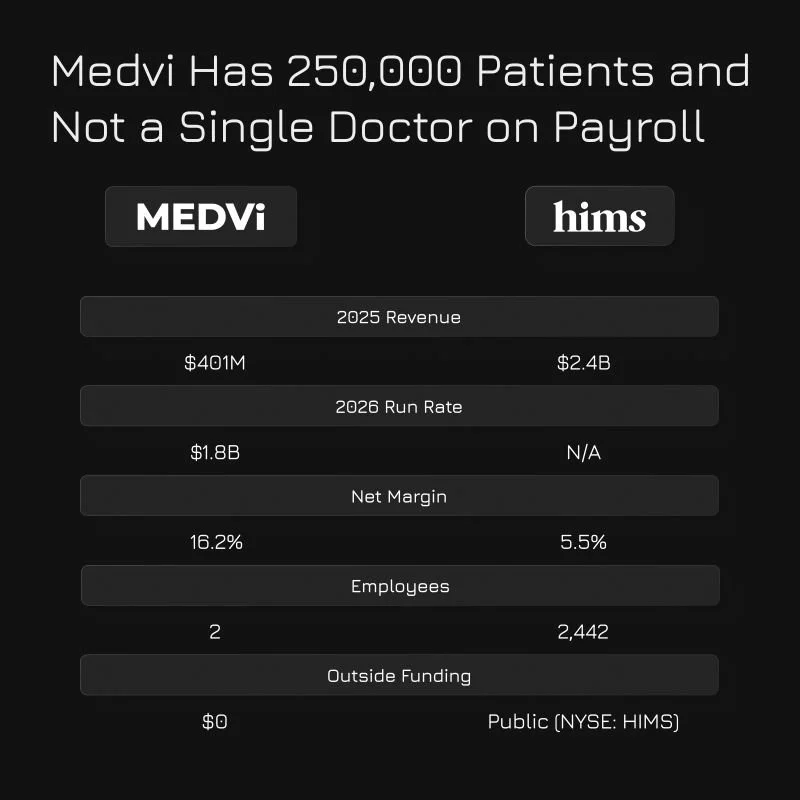
During the first month, the company got 300 clients, and in the second, 1,000 more. Medvi quickly became one of the top clients of CareValidate and OpenLoop, with the companies saying that they were flabbergasted by the start-up's growth speed. By the end of 2025, the company had brought in around 250,000 customers and had reached $401 million in annual revenue. Thanks to its business model, Medvi was able to retain a net profit margin of 16.2% ($65 million), in contrast to competitors like Hims and Hers, which had a net profit of 5.5%. By early 2026, the company served over half a million patients.
Matthew has started to reinvest the profits back into the business with the aim of expanding its product range to provide other health products. In February 2026, Medvi started selling more men’shealthmedicines, like erectile dysfunction drugs. This medicament reached 50,000 in its first month, and Gallagher expects it to outperform the GLP-1 by August 2026. The latest addition was a healthy meal delivery plan in March 2026, which again is handled by OpenLoop, and according to Matthew Medvi’s next step is to expand into women’s health with products like hormone therapy drugs, supplements and skin care products.
Тhe difficulties
During the initial process of building the infrastructure on which the Medvi business operates, Matthew was faced with many difficulties. The challenge of building an operational network of agents, connecting the various softwares, which were needed for the different functionalities. An example Gallagher has given is that in the beginning, he was concerned about the customer service bots sticking to the task at hand, which he had to test by asking the agents for lasagna recipes, which, according to his words, took some time to stop the chatbots from providing them. Additionally, the checkout system wasn’t working smoothly and sometimes fabricated drug prices or made up products that Medvi wasn’t offering. And when customers wanted to talk to a person, Medvi’s customer service chatbot transferred them to Gallagher’s cellphone, which resulted in more than 1,000 customer service calls, he had to recall.
Despite the many benefits of managing a company practically by himself, a little mistake showed Gallagher why a team is crucial. In March 2025, the entrepreneur made a minor change in the website with the intention of making an improvement and went on a hike. While he was on his walk, he received a call from his media agency telling him that there had been no orders during the past hour. He realised that he must have broken something in the purchase process, but there was no one else to fix it but him. He rushed home to resolve the issue. According to him, during the time the website was down, he lost around 200 customers.
This made Matthew realise that by being the only employee, there was no one to fall on when there was a problem. To fix this weak point in his business, he hired two contract engineers. This kept him in a position of no obligations. Additionally, he hired his only employee - his brother, whose job was to take some of the work off of Gallagher, so he could focus on more important tasks, like fixing some shortcuts he had taken initially.
According to Gallagher, some human interaction is still needed. Medvi has begun assigning human account managers, all hired on contract, to some customers with the idea that the account managers will create a more personal connection by getting to know clients and remembering details like birthdays or children’s names, creating higher customer satisfaction. Abiding by the main ideas of the founder, Medvi’s seven account managers, who have several hundred clients each, use AI to manage that many relationships.
Perhaps the most notable question that this raises is to what extent a single person can utilise AI automation to build the business, and at what point does it become impossible to manage by oneself? Furthermore, while it is indisputable that Artificial Intelligence agents increase productivity, efficiency is by no means the only requirement for a successful business.
The legal controversies
In order to move so quickly, Gallagher has used morally and legally questionable strategies, which have resulted in a negative impact on the company.
Concerns were raised about the deepfake photos used on the before-and-after photos used on the website. Additionally, some of the initial ads were also AI-created, putting mainstream media logos like the New York Times and Bloomberg, misleading that the company had been featured there, although Medvi had only advertised there
In February 2026, the Food & Drug Administration (FDA) sent the company a letter regarding false or misleading claims on its website, implying that Medvi was the producer of its own drugs and that those drugs were FDA-approved, when they weren’t. During that period, the FDA issued letters to more than 30 telehealth companies concerning similar marketing violations. Additionally, false claims in their advertisements, like “approved by doctors” or “trusted by experts”, have been further discussed as misleading for customers about the safety testing of the drugs. According to Nancy Glick, NCL’s (National Clarity League) director of food, nutrition and obesity, “What Medvi is doing violates the FTC act.”
On March 20, 2026, a class action lawsuit was filed, which involved at least 100,000 people. The lawsuit alleges that Medvi is benefiting from affiliate spam. It cites that emails with subject lines like “This might be the easiest way to start Ozempic” route consumers to Medvi’s platform.
A separate problem surfaced when various sources found that there were hundreds of Medvi ads on the Meta platform running under accounts impersonating doctors. Investigators found more than 5,000 active Medvi ads as of April 3, 2026. That number has significantly fallen to 2,800, following a Business Insider investigation.
The aforementioned raises the question of the moral limitations of integrating AI into the business world. While the efficiency it provides is undeniable, the fast-paced growth that the Artificial Intelligence sector is experiencing is in direct correlation with the dangers that the improved tools pose. Especially dangerous are photo and audio-generating agents, as they contain the capacity to create not only harmless and helpful content, but also fabricate convincing imitations of any real person. This makes them capable of deceiving people, which would be not only immoral, but also poses risks to said people.
Is AI the future of business?
AI is exponentially becoming more closely intertwined within the daily usable tools of every person, whether it is used to delegate simple tasks, as a better search engine, to help deal with demanding projects faster and more efficiently, or even to build a $1 billion+ company.
This creates the possibility to soon make obsolete the current business start-up model of raising capital, through raising investments, and investing it in the workforce. Especially with the continuous development of AI tools from companies like Google, DeepSeek, OpenAI, and other companies, the possibilities in which founders and managers could incorporate these tools are increasing exponentially.
The instances of such lean companies, which have achieved high revenue, are also growing. Gamma, an AI platform which helps people create presentations, documents and websites, was founded in 2020 by Grant Lee, Jon Noronha, and James Fox. Though initially, their growth was slow, in 2023, they decided to incorporate AI into the core of operations, focusing on user experience and “time-to-value”. This increased their sign-ups from hundreds a day to 20,000+, allowing it to reach $100 million in ARR (Annual Recurring Revenue) and a $2 billion+ valuation with only 50 employees.
The cases of already established companies, which are cutting their workforce in favour of AI integration, are also rising. The fintech giant Block, a global financial technology company focusing on digital payments and Bitcoin, at the beginning of 2026, has reduced its employee headcount by relatively 40% from over 10,000 to less than 40%. Other examples are Amazon, which has eliminated more than 30,000 corporate roles as of early 2026 - 14,000 in October 2025 and 16,000 in January 2026. Meta is also undergoing restructuring, laying off around 10% of its workforce (~8,000 employees) to fund a massive investment, estimated to be approximately $135 billion in AI infrastructure.
Nevertheless, human touch is still essential. While AI tools have the capabilities to improve productivity, through outsourcing repetitive or challenging tasks, it still doesn’t have the capability of human reasoning, intuition and most importantly, personal relationships. According to the World Economic Forum, a global study by Zurich Insurance Group, conducted with Stanford University professors, has shown that 73% of customers don’t engage with companies which don’t show empathy and 43% move to other companies. Additionally, the study found that 71% of people believe that AI cannot create a genuine human connection, and an astounding 92% said that they value direct human interaction over availability. This illustrates that human connection is becoming increasingly valuable as AI continues to take over more roles.
With authentic human connection playing such a pivotal role in customer retention, it becomes clear that, though possible for a one-person AI-only company to generate revenue and bring in customers, it most likely wouldn’t be sustainable for long, as is the case with Medvi and Gallagher having to recall more than 1,000 customer calls. This makes the business model of combining AI tools for efficiency and people for authenticity the most attractive opportunity for new founders or managers wanting to restructure in a constructive way.
On the other hand, we have the other departments that do not have contact with customers. This raises the question if the roles those employees take make them obsolete? As seen in the case of Medvi, it becomes evident that, while efficient, relying only on AI agents and oneself is impractical, as it allows for no room for error and requires the full and undivided attention of the founder. Combined with other cases of already established companies integrating AI reveal that even at the advanced stage, which is currently AI, most positions require human intervention, and workers are still needed. The differentiating factor between the ones which will hold their positions and the ones that will be laid off becomes not their know-how skills, but rather their managerial and adaptation skills or in other words, the people who can adapt to the continuously faster development of AI and the ones who can manage it to execute the tasks to the highest standard.
However, the most important point to make is that with the speed of innovation of AI, all predictions of the effects which it will have in the field of businesses remain hard to support. Although the current trends suggest perpetual integration, it is unknown how internal and external factors will affect the optimal combination of human touch and Artificial intelligence to create the ideal business model.
— The Financier ReviewResources
Buntz, B. (2026, April 4). The New York Times spotlighted MEDVi. The FDA had already warned the self-proclaimed “fastest growing company in history.” - Drug Discovery and Development. Drug Discovery and Development. https://www.drugdiscoverytrends.com/the-new-york-times-spotlighted-medvi-the-fda-had-already-warned-the-self-proclaimed-fastest-growing-company-in-history/
Conny Kalcher. (2025, November 6). Human connection and the future of business: Study. World Economic Forum. https://www.weforum.org/stories/2025/11/empathy-business-return-on-investment-new-study/
Griffith, E. (2026, April 2). How A.I. Helped One Man (and His Brother) Build a $1.8 Billion Company. The New York Times. https://www.nytimes.com/2026/04/02/technology/ai-billion-dollar-company-medvi.html
Josipa Majic Predin. (2026, April 2). AI And $20,000 Helped One Man Build A $1.8 Billion Telehealth Startup. Forbes. https://www.forbes.com/sites/josipamajic/2026/04/02/ai-and-20000-helped-one-man-build-a-18-billion-telehealth-startup/
Newsham, J. (2026, April 6). AI-powered telehealth company Medvi appears to have an AI doctor issue. Business Insider. https://www.businessinsider.com/medvi-ai-weight-loss-millions-ai-advertising-legal-compliance-challenges-2026-4
Roeloffs, M. W. (2026, April 23). Meta Slashes 8,000 Jobs—Latest In AI-Layoff Surge. Forbes. https://www.forbes.com/sites/maryroeloffs/2026/04/23/meta-cutting-10-of-company-in-push-for-efficiency-as-ai-related-layoffs-soar/?st_source=ai_mode
Sherman, E. (2026, March 2). Block’s Huge Layoff Shows An Ugly Future For Workers. Forbes. https://www.forbes.com/sites/eriksherman/2026/03/02/blocks-huge-layoff-shows-an-ugly-future-for-workers/
Nikolay Marinski
Chief Business Analyst, Financial Analyst.
The Financier Review
© 2026 The Financier Review. All rights reserved.