Behavioural Analysis of Customers in Financial Markets: Psychological Characteristics and Behavioural Patterns.

Photo by Alina Grubnyak on Unsplash
Nikola Radostinov is a guest contributor to The Financier Review. He studies Economics and Social Sciences at the Vienna University of Economics and Business (WU), with a focus on Finance and International Marketing, where he also works as a teaching tutor and research assistant in microeconomics. His interests centre on behavioural economics and the analysis of financial markets.
Why behaviour moves markets?
In the recent decades the concept of customer behaviour has become an integral part of the process of constructing a relevant marketing strategy. The shift from a resource-centred to a customer-centred approach has led to various findings, regarding the reshaped implications of conventional qualitative and quantitative analysis instruments, fundamentally altering the way companies understand and respond to their target audiences.
Additionally, this phenomenon has found its particular relevance in the marketing strategies, applied to customers in the global financial markets, where the distinctive characteristics of financial actors and products further raises the importance of understanding customer behaviour. Unlike conventional consumer markets, financial markets are defined by higher uncertainty, information asymmetry and long-term consequences of individual consumer decisions, all of which underline the role of behavioural determinants in the decision-making process.
The following analysis aims to examine the extent of influence of several key factors, shaping customer behaviour and decisions, while also re-evaluating their relevance for consumers within the specific context of financial markets, considering the differences in the behavioural patterns of general consumers and financial market participants.
The Hidden Architecture of Choice
Consumer behaviour is a complex interdisciplinary concept, which has been defined by various experts in the fields of psychology, sociology and cultural anthropology. Kotler and Keller (2012) state consumer behaviour as the “process involved when individuals, groups or organisations select, purchase, use or dispose of a product, a service, an idea or an experience, in order to satisfy their needs and desires”. Through this definition, several key takeaways have emerged, regarding the main factors, which shape the decision-making process.
Recently, Dr. Rekha Vyas, a specialist in modern understandings of consumer behaviour, has adopted an interesting approach to analysing behavioural patterns (Vyas, 2025). In her work she differentiates six main internal and external factors, which influence the decision-making process of customers in modern society - psychological, social, economic, cultural, technological and personal factors. The six-factor model can be interpreted as an extension of the PESTEL analysis, which focuses entirely on external macroeconomic forces, while neglecting the individual preferences and attitudes of people and communities. By combining several aspects of the PESTEL framework with some personal influence factors, Dr. Vyas was able to create a qualitative tool for understanding the various dimensions of the decisionmaking process.
The Human mind Under Uncertainty.
Psychological factors play an important role in consumer decisions, as they take into consideration the internal influences that determine the abilities of individuals to process given information and to form their own judgement, including motivation, perception and attitude towards information. These factors explain how consumers process and interpret market trends, form their own individual beliefs about products and how those beliefs affect their purchasing behaviour (Vyas, 2025). They also influence their attitude towards risk and risk aversion, as well as fosters a cognitive bias that could undermine the consumer’s ability to properly evaluate certain situations and could lead to irrational decision-making.
“An investment said to have an 80% chance of success sounds far more attractive than one with a 20% chance of failure. The mind can’t easily recognize that they are the same.”
In the financial world, psychological factors find their most direct application in the analysis of risk preferences under uncertainty. Investors are typically categorised into three main riskperception profiles - risk-averse, risk-neutral and risk-loving investors. Beyond these preferences, behavioural finance has continuously documented how these psychological traits have sometimes caused investor decisions to differ from the predictions, prognosed by financial expects and economists, often resulting in suboptimal portfolio diversification decisions and higher volatility to sudden market trend changes (Dasari et al., 2025)
Social Factors: Why Investors
Copy Each Other.
Social factors can have a severe impact on consumer behaviour as well, particularly through the influence of family, peer groups and social status on individuals, who tend to adapt their choices, based on societally accepted values and norms. The people in a consumer’s social environment can significantly shape their purchasing decisions and encourage certain consumption behaviours (Vyas, 2025). This leads to the conclusion that social influence can subconsciously change existing fully formed customer preferences or alter them entirely.
Within financial markets, social factors could contribute to the phenomenon “herd behaviour”, where investors follow the actions of other, often more experienced or renowned specialists, rather than relying on their own independent financial analysis (Bikhchandani et al., 2000). This can amplify market trends and even lead to the formation of financial bubbles or sudden market crashes. Thus, financial markets often reflect a more collectivistic approach, rather than fundamental values. Such tendencies can especially be observed during periods of high uncertainty or market instability, for example during wars or a pandemic.
The Economics of Every Choice
Economic factors are also crucial in shaping consumer behaviour, as they directly affect their purchasing power. Such factors are for example income levels, current economic conditions like stagnation and price sensitivity. Macroeconomic changes in the environment, including inflation or financial instability, can further shift the spending priorities of customers and their product or service choices (Vyas, 2025). Regardless of the other influence factors, the economic limitations could often alone determine the feasibility of a purchase or an investment, making them a fundamental structural determinant of consumer behaviour.
In financial markets economic factors play a central role in shaping investment decisions, as changes in interest rates, inflation and income levels directly affect the risk tolerance of consumers, the asset allocation and the return on investment. Specifically during an economic crisis investors tend to adopt more conservative financial strategies, prioritising capital security over expected returns (Eleuch et al., 2025). Therefore the macroeconomic conditions could actively redirect investment flows across different asset classes, applying economic pressure on the individual behaviour patterns.
The Culture of Risk.
Cultural factors are also a crucial milestone in consumer behaviour, shaping the customers values, beliefs and norms, which determine the different acceptancy levels within a given society. Traditions, lifestyle patterns and cultural expectations guide consumption choices and long-term preferences (Vyas, 2025). Their significance lies in the fact that they operate at a deep, often subconscious level, forming a behavioural basis, upon which other factors are built.
In this way the different psychologic and personal factors may lead to different decisions, depending on the culture of origin of consumers.
In the context of financial markets, cultural factors influence attitudes towards saving, investing, and risk-taking. Societies with a strong culture of financial prudence may favour conservative investment strategies, while others may be more open to speculative opportunities. Variations between financial markets are therefore not only economic in origin but also culturally embedded, affecting how investors respond to similar macroeconomic conditions in markedly different ways.
Has Investment Gotten too easy?
Technological factors have continuously affected consumer behaviour, mostly by shaping customers’ access to information and the automatisation and autonomation of processes. The development of digital platforms has allowed consumers to compare products, access reviews, and engage in transactions with unprecedented efficiency (Vyas, 2025). This has significantly increased the speed and convenience of the decision-making process, while simultaneously rising consumer purchasing options, in particular regarding the accessibility, personalisation and immediacy of a product or a service.
In financial markets, technological advancements, such as online trading platforms and mobile investment applications, have made market participation accessible to a broader audience. However, this access also brings risks, connected to the consumer behaviour patterns - the immediacy and ease of digital trading can encourage more frequent, impulsive decisionmaking, contributing to heightened market volatility (Amin, 2025). Consequently market dynamics and investor reactions are being accelerated, making financial markets more instable and easily shifted from other external factors.
Risk is a Function of Age.
The personal factors include individual characteristics of customers, such as age, income, occupation, lifestyle and personal values, all of which directly influence a consumer’s preferences and purchasing decisions. These factors determine both the needs of consumers and their capacity to satisfy them (Vyas, 2025). Reflecting the specific circumstances of each individual, personal factors have recently increased their importance with the shift to a marketing approach, which values and considers the individual customer by introducing a higher level of possible individualisation on products. As a result, personal traits are being considered not only as a factor in the behavioural pattern analysis, but also as an attitude settler towards the other behavioural determinants.
In financial markets, personal factors have a strong influence on investment behaviour, as individuals with different income levels, life stages and financial goals adopt different investment strategies. Younger investors may be more willing to accept short-term volatility in pursuit of long-term capital growth, while older individuals tend to prioritise capital preservation and income stability (Korniotis and Kumar, 2009). The broad variety of financial investment opportunities, including the possibility to adapt certain aspects like investment period or perpetuity structure, also plays a fundamental role in the market dynamic, enabling a high level of individualisation, based on the personal circumstances, goals and risk tolerance of investors.
Re-evaluation of the Six-Factor Model: Empirical Evidence
The six-factor model also finds its quantitative foundation in empirical research. In 2023 the Croatian researchers Marko Šostar and Vladimir Ristanović conducted an empirical analysis, based on the Analytic Hierarchy Process (AHP) - a multi-criteria decision-making method used to rank alternatives based on pairwise comparisons of specific criteria (Saaty, 1977). Their study breaks down the consumer decision-making process reasonings into more than thirty criteria, grouped into four categories - cultural, social, personal and psychological factors.
The analysis was structured around three statistical hypotheses: “Do all factors affect consumer behaviour equally?”, “Do personal factors have a dominant influence on consumer behaviour?” and “Is an individual's income key to creating individual purchasing habits?”. The data was collected from a sample of 559 respondents in the Republic of Croatia, who compared criteria two by two pairwise, assigning each of them an importance score, with which they were converted into weighted priority rankings.
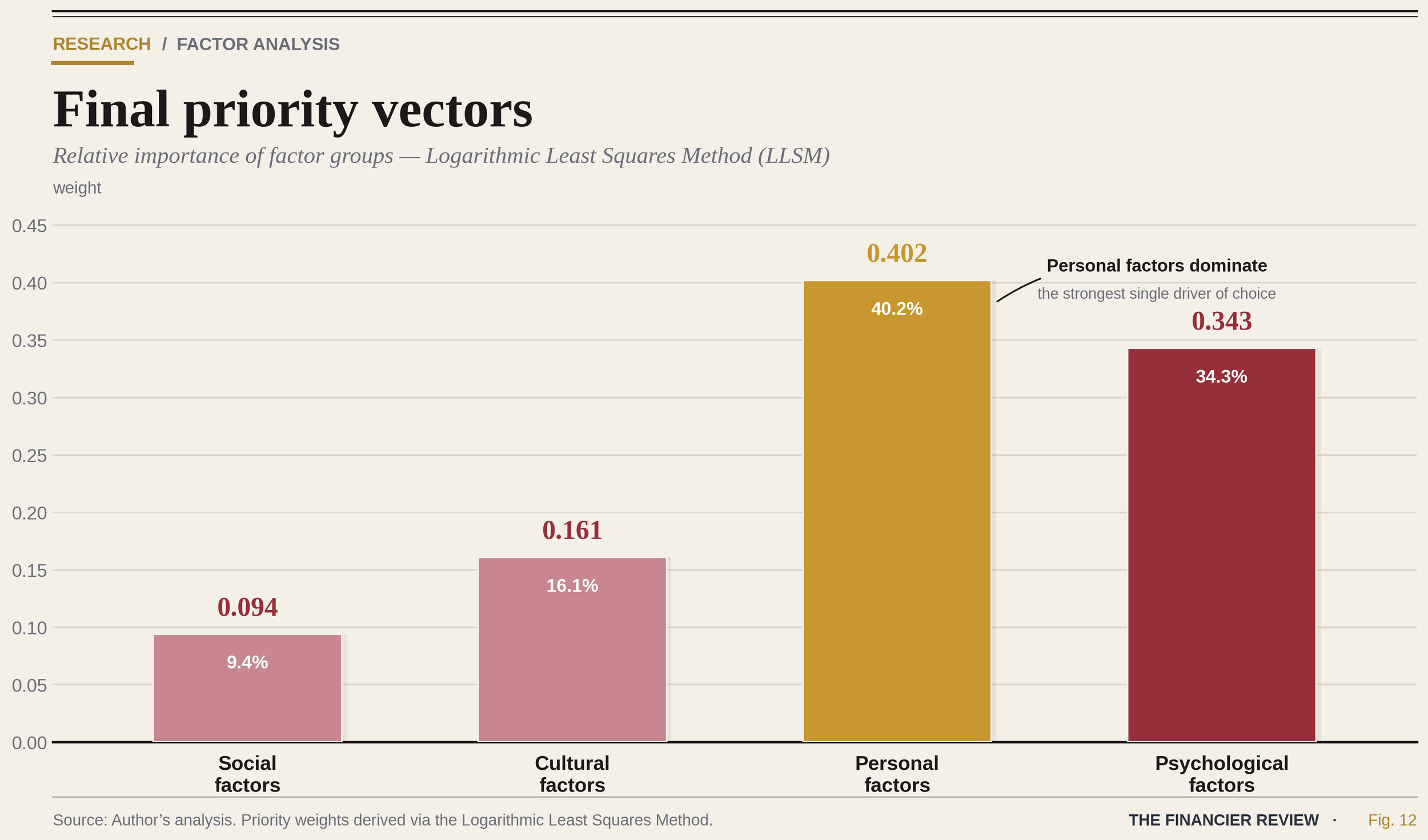
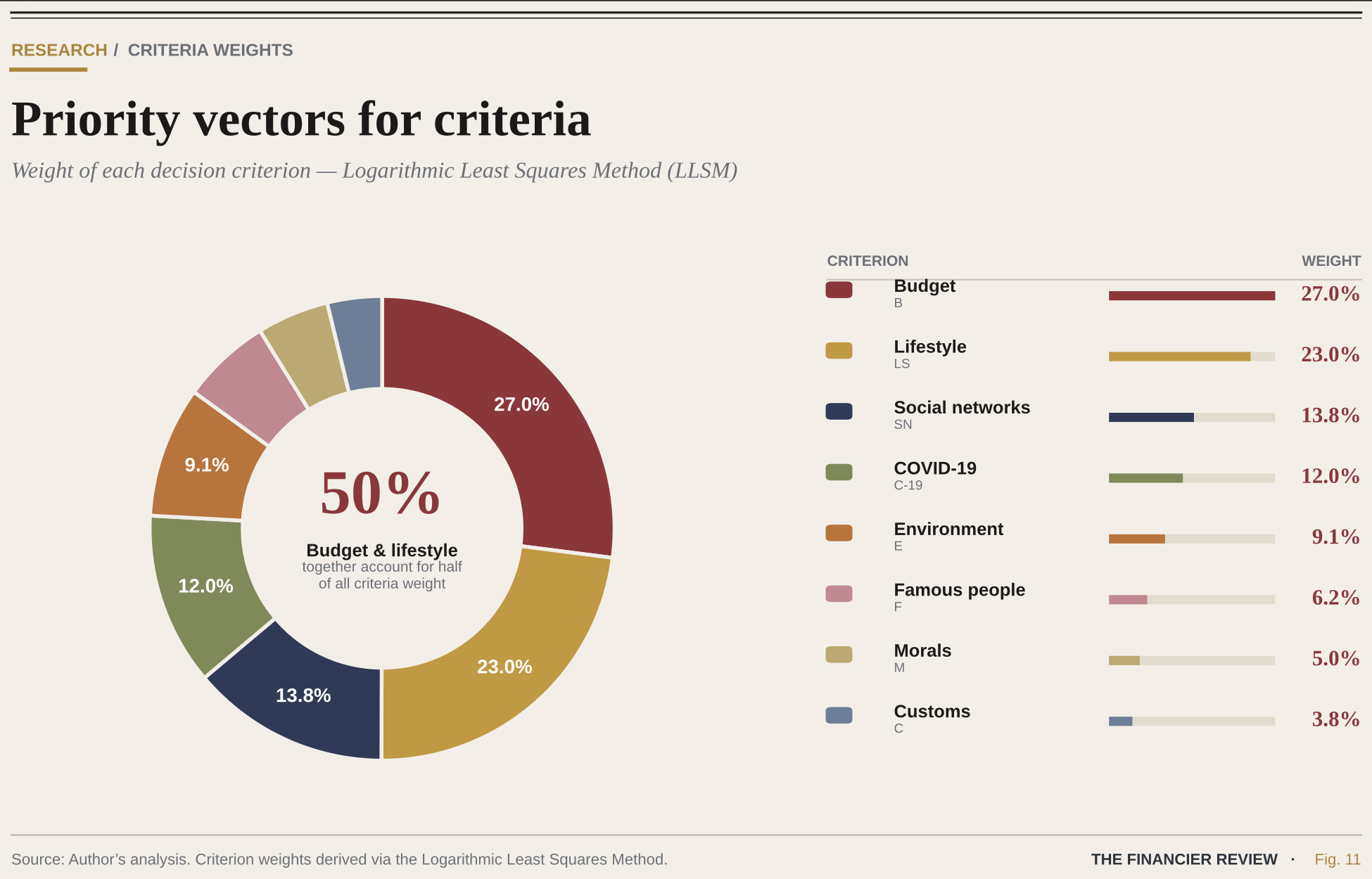
The results from ŠostarandRistanović’s empirical research has led to various conclusions about the relevance of the factors, namely a clear differentiation among them. According to the AHP, the sample respondents have ranked the personal and psychological factors as of utmost importance during the decision-making process, weighting them at 0.401 for personal factors and 0.344 for psychological factors. At the same time cultural factors received a weight of 0.161 and social factors of only 0.094, corresponding to only a quarter of the total influence on a decision of customers. At the same time, if we analyse the individual factors, 8 factors can be highlighted to have the highest influence on customer decisions – budget, COVID-19, social networks, environment, customs, morals, famous people and lifestyle. From the 8 aspects highest relevance for consumers are budget with 0.27 and lifestyle with 0.23 weighted score. Unsurprisingly, both of those factors happen to be personal factors, which further confirms the statement that internal behavioural factors are conclusive for the final decision of consumers.
These results confirmed the second and third hypotheses of the study, while rejecting the first - the factors do not influence consumer behaviour equally, because personal factors, driven primarily by financial capacity, have the biggest influence on the decision-making.
Graph Design: The Financier Review.
These findings carry significant takeaways, crucial for the analysis and understanding of financial markets. If we compare the results of the AHS research results with the six-factor model, proposed by Dr. Vyas, a significant observation can be highlighted – while the theoretical framework treats all six factors as relevant dimensions of consumer behaviour, the empirical evidence suggests a clear hierarchy among them. Particularly, personal and psychological factors, which correspond to the internal dimensions of the model, can be identified as the main contributions to the investor’s behavioural patterns. The consumers in financial market are primarily influenced by their own individual beliefs, values and internal cognitive processes, rather than by social norms or cultural frameworks. This aligns with the established tendencies in behavioural finance, which evaluate cognitive biases, loss aversion and individual risk preferences as biggest drivers of investor behaviour, rather than collective or cultural pressure.
Graph Design: The Financier Review.
Where the Evidence Leaves Us
The conducted analysis of the six-factor model, further interpreted by the empirical findings of Šostar and Ristanović (2023), argues that consumer behaviour in financial markets is shaped by a complex mixture of internal and external factors and determinants, which shape the individual customer’s perception of consumerism. While all six aforementioned factor categories contribute meaningfully to the decision-making process of investors, the empirical evidence suggests that personal and psychological factors are of crucial for shaping behavioural patterns, while cultural, social, economic and technological forces provide a broader structural context of the decision-making process of consumers.
In the context of financial markets, this finding is especially significant. The complexity, risk and long-term consequences of financial products are considered as characteristics of paramount significance for investors, due to their perception being influenced by their own internal behavioural patterns. For this reason, they make investment decision-making particularly exposed to psychological biases, which are often externally incited.
At the same time, macro-level factors continue to shape the structural environment, in which individual decisions are made, affecting the current financial market behaviour of investors. As markets grow increasingly volatile, a comprehensive understanding of the internal and internal decision criteria of customers becomes essential for the right design and implementation of investment strategies and financial market policies.
References
Kotler, P. and Keller, K. L. (2012) Marketing Management. 14th edn. Pearson Education.
Vyas, R. (2025). Understanding Consumer Behaviour (1st ed., pp. 107-125). Noble Science Press. https://doi.org/10.52458/9789349381636.nsp.2025.eb.ch-07
Dasari, Rajesh, Sreenivas, T., Kumar, N, Panda, Hemanth & Reddy, B. (2025). Behavioral Biases and the Diversification Puzzle: Why Investors Fail to Build Optimal Portfolios. 23-26. https://doi.org/10.97248/IJBMS.2025869135
Bikhchandani, S., Sharma, S. (2000). Herd Behaviour in Financial Markets. IMF Econ Rev, 47, 279–310. https://doi.org/10.2307/3867650\
Eleuch, M., Souissi, N., & Mroua, M. (2025). Does the crisis period affect the properties of various financial assets: evidence from G7, BRIC, GCC countries.Cogent Business & Management, 12(1).https://doi.org/10.1080/23311975.2025.2451132
Amin, M. R., Nainggolan, Y. A., & Rahadi, R. A. (2025). The digital transformation of investment behavior: a systematic review of gambling tendencies in modern financial markets. Cogent Economics & Finance,13(1). https://doi.org/10.1080/23322039.2025.2568643
Korniotis, George & Kumar, Alok. (2009). Do Older Investors Make Better Investment Decisions?, The Review of Economics and Statistics. 93. 244-265. https://doi.org/10.2307/23015932
Šostar, M., & Ristanović, V. (2023). Assessment of Influencing Factors on Consumer Behavior
Using the AHP Model. Sustainability, 15(13), 10341. https://doi.org/10.3390/su151310341 Saaty, T. L. (1977). A scaling method for priorities in hierarchical structures, Journal of Mathematical Psychology, 15(3), pp. 234-281.
Nikola Radostinov
Guest Financial Analyst, Focus: Behavioural Economics and Finance.
The Financier Review
© 2026 The Financier Review. All rights reserved.