Deutsche Bank: 8 billion Dollar Money Laundering Machine.
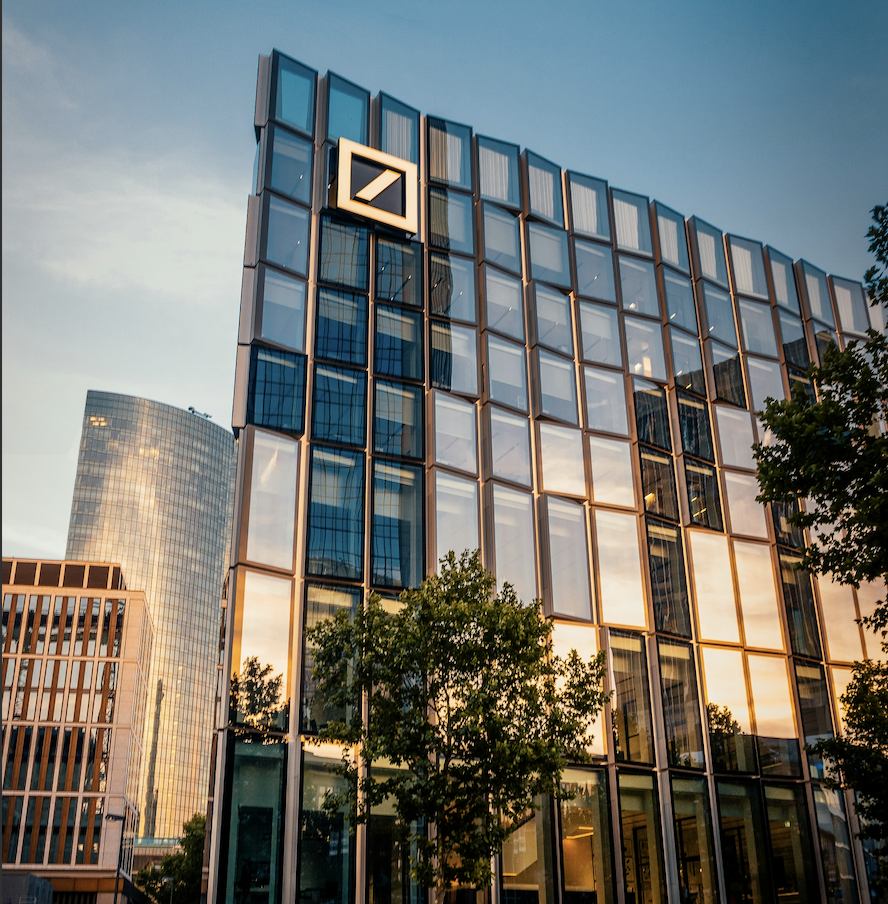
On the 28th of January 2026, 30 investigators from Frankfurt’s main prosecutor office walked into Deutsche Bank’s headquarters. The next morning, management of the bank reported $8.0 billion in net profit for 2025 - a number that can be described as the best performance in its 155-year history. As a matter of fact, both events describe the same institution.
To understand the controversy behind Germany’s largest bank we need to dive into the reason for its creation. Deutsche Bank opened in Berlin, 1870 with the main purpose to finance German exports. Incredibly, within its first years, the bank had already established branches in key international areas like Shanghai, Yokohama and London. Deutsche Bank owes its starting success on an old-school German business principle known as “hausbank”. In simple terms, the German companies and individuals used to have a go-to bank for most financial needs. Kind of like a long-term partnership where the customer handles day-to-day business in the same bank. And with that, for most of the next century Deutsche Bank was the hausbank: lending to German industry, sitting on company boards and staying for decades.
Well, that changed rather abruptly in the 1990s. Deutsche bought London's Morgan Grenfell in 1989 and nine years later in November 1998 it agreed to buy Bankers Trust for $10.1 billion, at the time the largest foreign takeover of a US bank. What few knew was that the long-term strategy for this bank was to compete internationally with giants like Goldman Sachs and JPMorgan. As it turned out, the buy-out gamble turned out to be most profitable. By the mid-2000s, trading desks in key locations like London and New York were producing the majority of the group’s profit.
And these same years produced record earnings. They also produced the cases that the bank spent the following decade paying for.
In April 2015, the German bank was fined by regulatory bodies in the US and UK over the manipulation of their LIBOR and other benchmark rates. To define, London Interbank Offered Rate was a benchmark interest rate used by major global banks to conduct short-term lending between each other. But more importantly than the specifics of the misconduct, Deutsche Bank was fined $2.5 billion. At that time, it was the largest LIBOR settlement of any bank, and its operating subsidiary in London pleaded guilty to this type of fraud known as a wire fraud. Just seven months later, in November 2015, the New York Department of Financial Services fined the bank $258 million over payments linked to US-sanctioned countries, amongst them Iran and Syria.
The following year proved to be even worse for the German bank. In June 2016, the US subsidiary of Deutsche Bank failed the Federal Reserve’s stress test. This test is crucial for stability of a bank and evaluates whether a banking institution has enough capital to withstand severe economic crises, while continuing to lend money to its clients. The International Monetary Fund (IMF) even claimed that Deutsche Bank is the largest net contributor to systemic risk among the world’s systemically important banks. In September the German bank announced that the US Justice Department was seeking for $14 billion in fines over mortgage-backed securities sold before 2008. At the end of the year the bank and the Justice Department came to an agreement and Deutsche Bank was fined $7.2 billion in January 2017, a $3.1 billion civil penalty with an additional $4.1 billion in compensations for homeowners.
By 2019 the bank was in its worse shareholder value episode with a share valued at only $8, just 24% of its value of $33/share in mid-2015. Following merger talks with Commerzbank, heavily pushed by the German Finance Ministry, the deal ultimately fell through in just six weeks. On the 7th of July the same year, the bank took drastic austerity and restructuring measures: an exit from global equities trading, 18,000 job cuts and a specialized unit to dissolve about $83 billion of risk-heavy assets. This whole process cost Deutsche Bank around $8.3 billion.
From 2011-2015 clients of Deutsche’s Moscow subsidiary bought Russian blue-chip shares in roubles. For clarification, a blue-chip share is part of an index tracked by the Moscow Exchange Blue Chip Index (MOEXBC), which covers the 15 most liquid and capitalized companies on the Russian market. More interestingly, related offshore companies sold the same owned shares, with the exact amounts, through Deutsche Bank’s London Branch, only this time for dollars. With the two trades cancelling out, resulted in roubles becoming dollars and leaving Russia. UK’s regulatory organ, the Financial Conduct Authority counted more than 2,400 pairs matched between April 2012 and October 2014. This equated to a move of over $6 billion, with an additional $3.8 billion regarded as suspicious one-sided trades. The grand total, quoted by regulators was roughly $10 billion.
In early 2017, the DFS (Department of Financial Services) fined Deutsche Bank $425 million with UK’s regulatory body adding about another $204 million (£163 million). And all of this being the largest anti-money laundering penalty ever given by the FCA at the time. Rather concerningly, the total fine amount of $629 million equated to only 6% of the money that was moved. Adding oil to the fire, the DFS found out that Moscow traders went with the scheme and did not report, since that meant more easy commissions while business for them was slowing.
Danske Bank, a multinational Danish bank, and more specifically its Estonian branch, processed around $227 billion in payments deemed suspicious from 2007 to 2015, mostly from Russia or other former Soviet states. Where Deutsche Bank comes into play is that they were one of the banks responsible for dollar-clearing. With Dollar clearing being a process of settling USD payments through a US correspondent bank.
Even more controversially, the German bank even declared Danske Estonia as high-risk as early as 2007, soon gave alerts on customers with Latvian and Russian links, but continued to process payments up until late 2015. Federal Reserve investigators even claimed that a significant portion of the cleared $267 billion involved high-risk customers. DFS review found problems with $618 billion in transactions for FBME, a Cypriot bank later blacklisted by the US Treasury. So needless to say, a controversial past.
In July 2020, the DFS fined Deutsche $150 million, over engaging with American financier and child sex offender Jeffrey Epstein. It was the very first penalty any regulator had given to ties with this controversial figure. Five years after his conviction in 2008, the bank took Epstein as their client and opened more than 40 accounts for him and related individuals and entities. Further, the German bank processed payments to alleged accomplices and victims, with cash withdrawals averaging $200,000 a year. Deutsche Bank formally cut ties with the convicted felon in December of 2018. Even more scandalously, internal messaging in the bank showed staff weighing the reputational risk against the revenue such client could bring. Deutsche Bank’s CEO, Christian Sewing even told his employees that onboarding Epstein “was a critical mistake and should never have happened.”
The exact same order covered Danske and FBME Bank. Three years later, on the 19th of July 2023, the Federal Reserve fined Deutsche another $186 million for slow progress on fixing the controls it had promised to repair in 2015 and 2017. $46.2 million of that penalty related directly to Danske Estonia.
Following all this controversy surrounding Germany’s largest by asset bank, numbers suggest that the turnaround has been present since 2020. Following a sixth annual in a row increase, in Fiscal Year 2025, net revenue rose by 7% to $36.3 billion with noninterest expenses falling by 10% to $23.4 billion. Mostly because 2024 carried large provision for litigation with Postbank. A record profit before tax rose 84% to $11 billion. Net profit about doubled since 2024 sitting at $8.0 billion. Cost-income ratio also saw a decrease from 76% to 64%, plus Return on Tangible Equity (RoTE) reached 10.3%. Common Equity Tier 1 (CET1), a bank’s highest quality regulatory capital ratio ended the year at 14.2%.
Intriguingly, Deutsche Bank met every target for 2025 that it had set. For a bank with such a colorful record, and one that routinely missed its own guidance during the mid-2010s, that is as important as the profit they generated. From said generated profit, the German bank paid out $3.3 billion for 2025, giving a dividend of about $1.13 / share. This brings total distributions from the bank at $9.6 billion in the period 2021-2025.
This year, the trend seems to continue. First half of the FY, Deutsche Bank saw a growth of revenue at 5% giving a figure of $20 billion, and post-tax profit reached $4.8 billion. These are the best six months in the bank’s history. With Q2 now over, this was the 20th straight quarter of year-on-year revenue growth. The RoTE metric for Q1 and Q2 was at 11.9% and the cost to income ratio almost 61%, being closer to the 2028 management target of below 60%. All four divisions earned at least 12% on tangible equity, with Asset Management at 44.4%.
Additionally, the nature of business is shifting away from trading. Private Bank clients’ assets reached a figure of $981 billion, which compared to management’s goal of $1.16 trillion for 2028. Asset Management took in $42 billion of net new money in the half, while IB delivered its best ever recorded second quarter. The Advisory and origination revenues up 20% in H1, which no longer single handedly carry the German group.
Management raised its 2026 net interest income guidance to above $16.2 billion, kept its revenue target of about $38.3 billion and announced a new $580 million buyback, paid for out of 2026 earnings. And now distributions run at a 60% payout ratio.
And here is another non-metric detail to show how far the brand has come along. DWS, the asset-management arm of Deutsche Bank, listed itself in 2018, it decided against its original name Deutsche Asset Management, with a large focus to keep distance away from legal problems associated with Deutsche Bank Group. This September, DWS announced a return to their original name as Deutsche Asset Management, effective in November. A great symbol for the bank’s cleaner image, a name once tried to be hidden now to be displayed for international clients to see.
Reported link: companies tied to Roman Abramovich
Question: were suspicious reports filed too late?
Now let’s focus on the present, in January 2026, a search was launched covering Deutsche Bank’s Frankfurt HQ and its office in Berlin. Prosecution claimed that they were investigating unnamed managers and employees that were suspected for money laundering and breaches of Germany’s Anti-Money Laundering Act. This investigation covered transactions from 2013-2018. Local media reported that the case revolved around companies linked to Russian oligarch and businessman Roman Abramovich. The same person who has been under EU sanctions since March 2022, shortly after the beginning of the full-scale war in Ukraine in February 2022. The blame was whether the bank filed suspicious activity reports too late.
Going back to 2018 this was not the first search as well. November 2018, about 170 police and tax investigators stormed through Deutsche’s Frankfurt office over setting up offshore companies for their clients. Four years later, prosecution searched the bank again over potentially late suspicious activity reports, ending with a fine of $7 million. In February 2025, BaFin fined the bank for three separate regulatory breaches.
Considering the past of Deutsche Bank, any penalty from the current case is likely to be small compared to their $8 billion in annual profit. More importantly, this time window could prove to be another massive reputation hit. If we recall previously 2013-2018 is the same period as the mirror trades, the Danske clearing and the Epstein accounts. With every new case being opened, Deutsche’s already weak reputation and proclamation for being different than what was back then deteriorates.
At around $39 on the 15th of September 2026, the shares trade at about 1.07 times tangible book value of roughly $36 per share, and at about 10 times consensus 2026 earnings. They are up by about 40% from their 52-week low of about $28 on the 23rd of March 2026, and just below the high of about $42 reached on the 8thof September. For most of 2016-2023, the stock traded well below book value. We can make a reasonable assumption that investors were pricing another fine for the German Bank Giant. Goldman Sachs upgraded the shares to buy in early September 2026, with a price target of about $51.
And with this all we believe that the case for the stock to prosper is returns on equity are rising, costs are under control, the fee-based businesses are growing faster than trading, and 60% of profit goes back to shareholders. If Deutsche reaches its 2028 target of more than 13% RoTE, 1.07 times book is cheap.
The case against: the market still applies a discount, and the bank keeps giving it reasons to. Deutsche has shown it can make money. It has not yet shown that its controls are as reliable as its trading desks.
There is no place to question that Deutsche is better run today than at any point in the last twenty years. The amazing financial and business results prove that same argument. What this same bank cannot decide is if the cleared payments for Danske Estonia, Moscow mirror trades and Jeffrey Epstein as a client reputation is behind them. With Prosecutors in Frankfurt still investigating we will have no answer until the file is closed and every record quarter will be read alongside it.
