Legal Dimension of The Israeli Palestinian Conflict
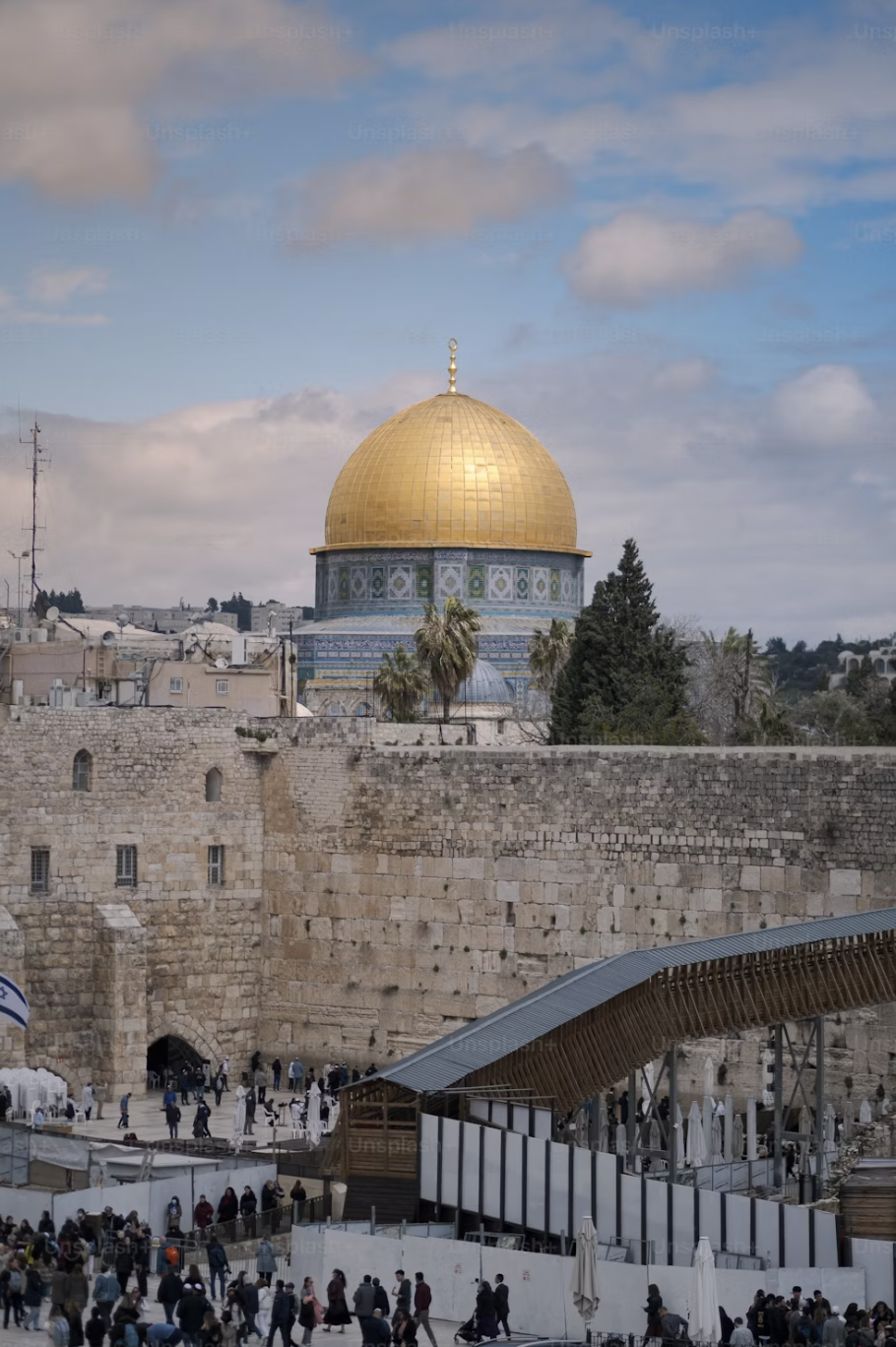
Dome of the Rock, West Stone Wall - Jerusalem.
The ongoing conflict between Israel and Palestine is one of the most complex disputes and has once again raised the question of the importance of international law. Witnessing images of destroyed cities, injured civilians, and allegations of war crimes has undoubtedly made us question the ability of the international legal framework to guarantee a peaceful solution of conflicts and regulate different state conducts. At the same time, governments and international organizations continue to strongly rely on the legal principles of international law. Based on contemporary challenges, we can all agree, to some extent, that international law is incapable of preventing wars from occurring. Despite the prohibition on the use of force mentioned in Article 2(4) of the United Nations Charter and the humanitarian protections established by international humanitarian law, armed conflicts continue to emerge in different regions of the world. On the other hand, the international legal framework has never been more significant, and states continue to use legal tools to justify their conduct through international provisions.
The Israel-Palestine conflict has raised complex legal questions concerning self-defense, occupation, statehood, self-determination, international humanitarian law, and the prohibition of genocide. It is fair to say that this conflict perfectly illustrates the interaction between law and power in international relations. That is why it is important to analyze the legal issues arising from the ongoing conflict, so that we can objectively evaluate whether international law can ensure compliance and effective enforcement, and this is what this article will try to do.
In order to understand the legal questions arising from the conflict between Israel and Palestine, it is necessary to examine the international legal framework that regulates and governs the use of force. As is well known, modern international law is based on the principles established after the Second World War, which are enshrined in the United Nations Charter. One of the most important principles, if not the most important one, is the prohibition on the use of force. Article 2(4) [i] of the United Nations Charter requires all states to refrain from the threat or use of force against the territorial integrity or political independence of any state. This provision was created as an alternative to using war as a legitimate instrument of foreign policy. However, there is an exception. Article 51 [ii] of the Charter recognizes the right of individual or collective self-defense against an armed attack. Therefore, states rely on this provision to justify military operations. This remains one of the most controversial legal questions, as distinguishing between lawful self-defense and the unlawful use of force is highly relevant in the context of the Israel-Palestine conflict.
Furthermore, international humanitarian law regulates the conduct of parties during armed conflicts. The most important treaties here are the four Geneva Conventions of 1949 and their Additional Protocols. They are important because they provide protection for civilians, prisoners of war and other groups affected by armed conflict. It is important to note here, that several principles are fundamental in international humanitarian law. First, there is the principle of distinction, which requires parties to distinguish between military objectives and civilians. Second, the principle of proportionality which prohibits attacks expected to cause excessive civilian harm in relation to the anticipated military advantage. Finally, there is the principle of military necessity, which permits only those measures necessary to achieve a legitimate military objective. The importance of these principles has become highly evident in the Israel-Palestine conflict, because they demonstrate that contemporary conflicts are not only military one but also legal.
The conflict between Israel and Palestine is an ongoing conflict that dates back to the mid-20th century, and it is by far regarded as one of the most complex disputes in modern international relations. However, the issue is not that similar to the Russian-Ukrainian war because the Israeli-Palestinian conflict involves several problems, like self-determination, recognition, as well as occupation and statehood. Another essential problem is terrorism and its definition. Under international law, there is no universally accepted definition of terrorism. However, many legal scholars and international instruments identify three important elements: the commission of a criminal act (actus reus), the intent to spread fear or coerce an authority (mens rea), and a transnational element, which refers to the fact that the act cannot be purely domestic; it must affect more than one country [iii]. Therefore, once again, it presents a major legal question within the international legal framework, which is still unanswered.
The attacks were initiated by Hamas on October 7, 2023, which obviously resulted in a large number of civilian deaths. In response, Israel acted in self-defense, as other countries recognized its right to invoke Article 51 of the UN Charter[iv]. In the following months, the Israeli army systematically attacked civilians and infrastructure, as well as limited humanitarian access to the Palestinian people. [v] This raised a lot of questions not only on a political level but also from a legal point of view. Many described Israel's actions as a violation of international humanitarian law, particularly the Fourth Geneva Convention. Common Article 3 of the Geneva Conventions[vi] states that it strictly prohibits murder, mutilation, cruel treatment, torture, and every kind of inhuman act against the personal dignity of individuals taking no active part in hostilities. Article 4 [vii] is also important because it defines who is protected by the Convention in the event of a conflict. Protected individuals are those who find themselves in the hands of a party to the conflict or an Occupying Power of which they are not nationals.
The position of Israel regarding these accusations is consistent. Israell believes that its actions are in accordance with international law [viii] and argues that the civilian harm is a tragic consequence of Hamas using densely populated urban areas and civilian infrastructure as shields. Furthermore, it questions the applicability of the Fourth Geneva Convention [ix]. Israel's main argument is that a territory can only be considered occupied if it was seized from a legitimate sovereign power. Because Israel does not legally classify the West Bank, East Jerusalem, or Gaza as "occupied territory" under international law, it rejects the formal application of Article 4 of the Geneva Convention, since Palestine is not considered a legitimate authority in the eyes of the Israeli government. Therefore, the Palestinians in these territories are not formally considered protected under Article 4 of the treaty[x].
However, since 1967, Israel has voluntarily agreed to comply with the humanitarian provisions of the Convention [xi]. Furthermore, Israel makes a distinction between basic humanitarian protections and administrative restrictions placed on the occupying force. On the one hand, Israel agrees to follow the rules that protect daily human survival, but on the other,it refuses to follow the rules that forbid a military force from controlling a land. In simpler words, Israel allows humanitarian aid to reach the Palestinian people, as long as it retains the full right to build Israeli settlements on this land, a condition that is highly disputed.
As these legal problems are still without a clear legal solution, the biggest legal issue, arguably, is Palestine’s right to self-determination. Under the international legal framework, self-determination is a jus cogens norm; therefore, no derogation is allowed. Article 1(2) of the UN Charter states that one of the purposes of the United Nations is to develop friendly relations among nations based on respect for the principle of equal rights and self-determination of peoples, and to take other appropriate measures to strengthen universal peace. [xii] The consensus of international bodies, including the UN General Assembly, the UN Security Council, and the International Court of Justice, is that the Palestinian people possess the right to self-determination [xiii]. Legally, these international bodies define the "Occupied Palestinian Territory" as a single, contiguous territorial unit, including the West Bank, East Jerusalem, and the Gaza Strip.
Nevertheless, the legal debate has changed following the 2024 Advisory Opinion of the ICJ. The General Assembly had asked the Court to evaluate the legal consequences of Israel's presence in the occupied territories. In its findings, the Court concluded the following:
The Court first affirmed its jurisdiction, finding that the request had been made in accordance with the Charter and that no compelling reasons justified declining the General Assembly's request for an advisory opinion.
The Court recognized the occupied Palestinian territory — the West Bank, East Jerusalem, and Gaza — as a single territorial unit whose unity and integrity must be preserved and respected. It found that Israel continues to exercise key elements of authority over Gaza, including control of its land, sea, and air borders, imports, and export taxes, so that its withdrawal has not entirely released it from its obligations under the law of occupation.
The Court held that the Hague Regulations form part of customary international law and bind Israel, which remains bound, too, by the International Covenant on Civil and Political Rights and the International Covenant on Economic, Social and Cultural Rights in respect of its actions in the occupied territory.
Addressing the effects of Israel's settlement policy, the Court noted that large-scale land confiscation deprives the population of basic means of subsistence, forcing them to leave, and that Israeli military measures have exacerbated this need to depart against their will. It found that the settlement policy — the transfer of Israeli settlers to the West Bank and East Jerusalem, and the maintenance of settlements — violates the Fourth Geneva Convention.
The extension of Israeli law to the West Bank and East Jerusalem, the Court found, is not justified under any of the grounds in Article 64(2) of the Fourth Geneva Convention; Israel has therefore exercised its occupation in a manner inconsistent with Article 43 of the Hague Regulations and Article 64 of the Convention. The Court further found that frequent land confiscations for reallocation to settlers are not temporary measures and thus breach the Convention's prohibition on the forcible transfer of protected populations.
The Court concluded that Israel's use of natural resources in the occupied territory is inconsistent with its obligations under international law and breaches its duty to act as an administrator, failing to respect the Palestinian people's right to permanent sovereignty over natural resources.
The Court asserted that the Oslo Accords cannot detract from Israel's obligations under the international law applicable in the occupied territory. They neither permit Israel to annex parts of the territory to meet its security needs nor authorize it to maintain a presence there.
Emphasizing the temporary nature of occupation and the illegality of sovereignty over occupied territory regardless of the occupation's length, the Court held that effective control must align with the prohibition on the threat or use of force. It concluded that Israel's policies — maintaining and expanding settlements, reconstructing associated infrastructure, exploiting natural resources, proclaiming Jerusalem as its capital, and broadly applying Israeli law in the West Bank — serve to entrench its control and are designed to remain indefinitely, with irreversible effects on the ground, constituting the annexation of large parts of the territory in breach of the prohibition on the use of force and the principle of non-acquisition of territory by force.
The Court stated that Israel is not entitled to sovereignty over any part of Palestinian territory, and that its security concerns cannot override the principle prohibiting the acquisition of territory by force. The Palestinian people's right to self-determination, it held, is inalienable and cannot be made subject to conditions.
Israel's continued presence in the occupied Palestinian territory is unlawful, and Israel is obligated to bring it to an end as rapidly as possible.
The Court held that Israel is obligated to provide full reparation for its wrongful acts, including restitution and compensation. Restitution involves returning land, immovable property, and all assets taken since 1967, including cultural property. Israel is also required to evacuate all settlers from existing settlements, dismantle parts of the wall in the occupied territory, and allow all Palestinians displaced during the occupation to return to their original residences. It must, in addition, make reparation for damage caused to all natural and legal persons in the territory.
The Court concluded that Israel's policies and practices violate Article 3 of the Convention on the Elimination of All Forms of Racial Discrimination — the prohibition against segregation and apartheid — and that Israel must cease all unlawful acts, halt new settlement activity immediately, repeal all legislation creating or maintaining the unlawful situation, and end measures aimed at altering the demographic composition of the territory. It considered that the United Nations, particularly the General Assembly and the Security Council, should consider the specific modalities and further action required to end Israel's unlawful presence as rapidly as possible.
Finally, the Court determined that all States are obligated not to recognize as legal any situation arising from Israel's unlawful presence in the occupied territory, and not to render aid or assistance in maintaining that presence.
However, Israel and the United States have a different legal interpretation. Their argument is that Palestinian statehood must be determined through direct bilateral negotiations. Also, the position of the United States and Israel is that statehood is not a symbolic declaration but a practical reality that can only work if it is negotiated with the neighboring states.[xv] As we know, the foundational principle of international treaty law is the principle of pacta sunt servanda ("agreements must be kept"). Israel and the U.S. emphasize that the Oslo I Accord (1993) and the Oslo II Accord (1995) are legally binding agreements signed by the Palestine Liberation Organization (PLO), the Palestinian nationalist coalition that is internationally recognized as the official representative of the Palestinian people in the occupied Palestinian territories. By signing, the PLO formally agreed to a specific mutually agreed process, including issues such as borders, Jerusalem, refugees, and the nature of the final entity.
From the U.S. and Israeli legal perspective, seeking a form of statehood through the United Nations is an attempt not to comply with, or to rewrite, the agreement, which they argue constitutes a breach of the Oslo Accords. In that regard, Israel highlights the importance of Article XXXI(7) of the Oslo II Accord,[xvi] which states:
Israel and the U.S. argue that when Palestine seeks non-member State recognition at the UN or joins international bodies (such as the International Criminal Court) as a "state," it is attempting to alter the legal status of the West Bank and Gaza from "negotiable territory" to "sovereign Palestinian land" outside the agreed framework.
A key point that the U.S. and Israel make is that, under the Oslo Accords, the West Bank was divided into Areas A, B, and C. The Palestinian Authority has completed civil control only over Area A (about 18% of the land). Israel retains full security and administrative control over Area C (roughly 60% of the land). Furthermore, the Accords deliberately left Israel with control over the borders, airspace, and territorial waters of Gaza.
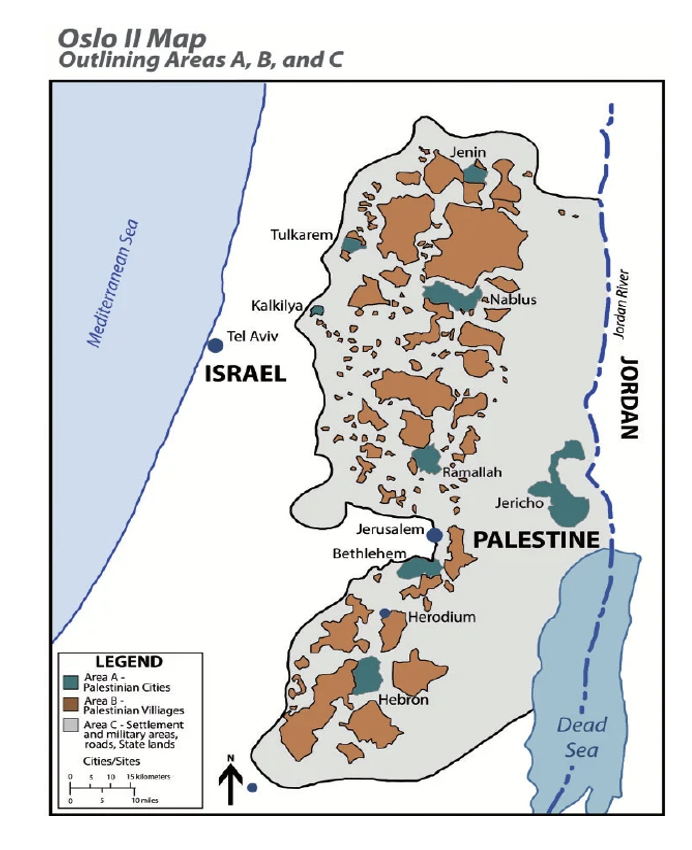
Figure 1.Map of the territorial division of the West Bank into Areas A, B, and C pursuant to the Israeli Palestinian Interim Agreement on the West Bank and the Gaza Strip (Oslo II Accord, 1995).
Source: “ResearchGate” https://www.researchgate.net/figure/Map-of-Areas-A-B-and-C-after-Oslo-II_fig1_276258691
The U.S. State Department and Israeli legal scholars argue that true statehood requires operational infrastructure, such as borders, customs, water rights as well as effective government control as it is one of the most important elements. For them, a UN declaration recognising the statehood of Palestine cannot grant "effective control" over territory where the Palestinian Authority had contractually agreed to allow Israel to retain administrative authority until another treaty that says otherwise is signed.
It is important to note here that the UN Charter does not explicitly describe the requirements of statehood. Article 1(2) only states that the right to self-determination is a fundamental principle for universal peace. The treaty that is most relevant in the context of Palestinian self-determination asand statehood is the Montevideo Convention of 1933. Article 4 of the Convention states:
For Palestine and its jurists, Article 4 is a counterargument against the idea that a state can only exist if it has the military or political power to back it up. First and foremost, Article 4 establishes the Declarative Theory of Statehood, the idea that a state exists a matter of objective fact, not because other nations allow it. Furthermore, the second sentence of the article is crucial: "The rights of each one do not depend upon the power which it possesses..." Palestine argues that its lack of military control, lack of control over its own borders, and lack of a standing army do not erase the fact that it has the legal right to statehood.[xix] Under this view, once an entity meets the basic criteria of statehood - a permanent population, a defined territory, a government, and the capacity to enter relations with other states - it qualifies as a state under international law.
Conversely, Israel and its legal supporters argue that Article 4 cannot be invoked by Palestine because Palestine does not satisfy the requirements necessary to rely on it [xx]. Article 4 applies to an entity that exists "upon the simple fact of its existence as a person under international law." Opposing legal arguments point to Article 1 of the same Convention, arguing that Palestine does not fully "exist" under international law because it lacks a unified, fully sovereign government that exercises exclusive control over a defined territory [xxi]. Articles 3 and 11 are also important provisions. Article 3 states that "The political existence of the state is independent of recognition by the other states [xxii]." Palestine uses this to argue that the refusal of Israel or the U.S. to formally recognise it does not prevent its legal existence, especially since more than 140 member states recognise the State of Palestine. Article 11 strictly forbids nations from recognising "territorial acquisitions or special advantages which have been obtained by force." [xxiii] This provision is frequently used by international bodies, such as the International Court of Justice, to argue that Israel's control over the West Bank and East Jerusalem cannot legally transform into sovereign territory.
Highlighting the importance of the Montevideo Convention, many jurists argue for the application of the Convention. The practice of international tribunals demonstrates that the Convention is still used as a valid legal argument, depending on the case. For instance, when the International Criminal Court had to decide whether it had jurisdiction over alleged war crimes in Gaza and the West Bank, it had to address whether Palestine was a "State." Interestingly, the ICC Pre-Trial Chamber bypassed a strict analysis of the Montevideo Convention. [xxiv] Instead, it ruled that because Palestine had been granted "non-member observer State" status by the UN and had successfully acceded to the Rome Statute, it counted as a State for the purposes of the Court's jurisdiction. Even though Articles 3, 4, and 11 of the Montevideo Convention are important, the general focus is on Article 1 of the same Convention. This provision outlines the four strict, objective criteria that an entity must possess to be recognized as a state under the Convention. According to Article 1 of the Montevideo Convention, "the state as a person of international law should possess the following qualifications: (a) a permanent population; (b) a defined territory; (c) government; and (d) the capacity to enter into relations with other states." [xxv]
The Israel-Palestine conflict demonstrates both the strengths and the limitations of contemporary international law. On the one hand, the conflict shows that international law is not capable of preventing armed conflicts from occurring. Despite the prohibition of the use of force under the United Nations Charter and the extensive protections established by international humanitarian law, armed conflicts continue to occur and civilians continue to suffer the consequences. The lack of an effective enforcement mechanism remains one of the greatest weaknesses of the international legal system. On the other hand, this does not mean that international law has become irrelevant. Throughout the conflict, both Israel and Palestine have relied on international law to justify their legal positions. International organizations, courts, and states continue to interpret and apply legal principles concerning self-defense, occupation, statehood, self-determination, settlements, and genocide. The proceedings before the International Court of Justice and the International Criminal Court further demonstrate that legal accountability continues to play an important role, even if it develops slowly.
Finally, the importance of international law should not be measured only by its ability to prevent wars, but also by its ability to establish legal standards. Contemporary conflicts show that military power may determine events on the battlefield, but international law continues to determine how those actions are judged by the international community. In my opinion, even though it may seem that international law is incapable of regulating the states conducts through its legal procedures, eventually the sanctions judged by the international community, will strongly affect the conflicting states that it would not be possible to continue any form of military actions, mainly because of international and economic pressure. However, states shall always comply with the sources of international law and its norms and establish their conduct within the limits of the inattentional legal framework. Otherwise, international law will transform just to a moral agreement between states which has no real practical application.
Bibliography and references
[i] United Nations Charter (1945): See Art.2 (4). It constitutes the primary legal authority for the prohibition on the threat or use of force against the territorial integrity or political independence of any state. https://www.un.org/en/about-us/un-charter/full-text
[ii] United Nations Charter (1945): See Art.51. It establishes the inherent right of individual and collective self -defense in the event of an armed attack and forms the legal basis for the discussion of Israel’s self-defense. https://www.un.org/en/about-us/un-charter/full-text
[iii] Thomson Reuters, “Elements of Crime” (January 30,2024): See the discussion under “Actus Reus”, “Mens Reas” and the constitutive elements of criminal liability. The sections rely upon the legal elements of terrorism discussed in Section III. https://legal.thomsonreuters.com/blog/elements-of-crime/
[iv] United Nations Charter (1945): See Art.51. https://www.un.org/en/about-us/un-charter/full-text
[v] International commission of jurists (June 30,2025): See the sections addressing forced replacement, restrictions on humanitarian assistance, and attacks against civilians concerning alleged violations of international humanitarian law (especially para.6).https://www.icj.org/palestine-israel-israel-must-immediately-stop-its-criminal-forcible-displacement-in-gaza/
[vi] Geneva Convention IV Relative to the Protection of Civilian Persons in Time of War (1949): See Common Art.3(1)(a) – (d), establishing the minimum humanitarian guarantees applicable during armed conflict, including the prohibition of murder, torture, cruel treatment and outrages upon personal dignity. https://ihl-databases.icrc.org/en/ihl-treaties/gciv-1949/article-3
[vii] Geneva Convention IV (1949): See Art.4(1), defining the category of “protected people “for the purposes of the Convention. https://ihl-databases.icrc.org/en/ihl-treaties/gciv-1949/article-4
[viii] Government of Israel, Key Legal Aspects of the Hamas-Israel Conflict: See the sections entitled “international Humanitarian Law”, “Occupation”, and Fourth Geneva Convention, setting out Israel’s position regarding the applicability of the law of occupation and the Fourth Geneva Convention to Gaza and West Bank. https://www.gov.il/BlobFolder/news/hamas-israel-conflict2023-key-legal-aspects/
[ix] Government of Israel, Key Legal Aspects of the Hamas-Israel Conflict: See the discussion concerning belligerent occupation, military necessity, and the legal status of the territories following Israel's withdrawal from Gaza in 2005.https://www.gov.il/en/pages/hamas-israel-conflict2023-key-legal-aspects
[x] International Court of Justice, Legal Consequences arising from the Policies and Practices of Israel in the Occupied Palestinian Territory, including East Jerusalem (Advisory Opinion, 19 July 2024): See paras. 88-94, especially paras.93-94. Para. 93 discusses Israel’s control Over Gaza’s land, sea and air borders, para. 94 says Israel was not entirely released from occupation law obligations. https://www.icj-cij.org/sites/default/files/case-related/186/186-20240719-jud-01-00-en.pdf
[xi] Human Rights Watch. See the section discussing Israel's declared policy of voluntarily applying the humanitarian provisions of Geneva Convention IV notwithstanding its position regarding the Convention's formal applicability.https://www.hrw.org/reports/2001/israel/hebron6-04.htm
[xii]United Nations Charter (1945). See Art. 1(2), recognizing the principle of equal rights and self-determination of peoples as one of the purposes of the United Nations. https://www.un.org/en/about-us/un-charter/full-text
[xiii] United Nations General Assembly Resolution A/RES/80/195: See the operative paragraphs reaffirming the Palestinian’s people right to self-determination. https://www.un.org/unispal/document/the-right-of-the-palestinian-people-to-self-determination-a-res-80-195-general-assembly-resolution/
[xiv] International Court of Justice, Legal Consequences arising from the Policies and Practices of Israel in the Occupied Palestinian Territory, including East Jerusalem (Advisory Opinion, 19 July 2024). paras. 22-50 (jurisdiction and discretion); paras. 88-94 (Gaza and law of occupation); paras. 104 -110 (applicable law); paras. 111-156 (settlement policy); paras. 157-179 (annexation); paras. 224-229 (racial segregation/apartheid under CERD); paras. 230 -243 (Palestinian right to self-determination); paras. 255 - 262 (illegality of Israel’s continued presence); paras. 267-272 (legal consequences for Israel, including reparation); paras. 278 - 279 (obligations of non-recognition and distinction by third States); para. 285 (operative conclusions). https://www.icj-cij.org/sites/default/files/case-related/186/186-20240719-jud-01-00-en.pdf
[xv] United Nations Information System on the Question of Palestine (UNISPAL):See the documents relating to the Oslo peace process and the permanent status negotiations, which set out the international diplomatic framework governing Palestinian statehood. https://www.un.org/unispal/document/
[xvi]Israeli-Palestinian Interim Agreement on the West Bank and the Gaza Strip (Oslo II Agreement, 1995): See Art. XXXI, in particular Art. XXXI (5)-(7), governing the obligations of the Parties pending the outcome of permanent status negotiations. https://www.un.org/unispal/document/
[xvii] Israeli-Palestinian Interim Agreement on the West Bank and the Gaza Strip (Oslo II Agreement, 1995): See Art. XXXI (7), providing that neither Party shall initiate or take steps altering the status of the West Bank or Gaza pending permanent status negotiations. https://www.un.org/unispal/document/
[xviii] Montevideo Convention on the Rights and Duties of States (1933).See Art. 4, establishing the juridical equality of States irrespective of their effective power or capacity to enforce their rights.https://www.jus.uio.no/english/services/library/treaties/01/1-02/rights-duties-states.html
[xix] Al-Haq, UN Initiatives - Questions and Answers:See the discussion concerning the declaratory theory of statehood and the legal consequences of recognition under contemporary international law. (Name of the paragraph:“Is Palestine a State under international law? What is the international community’s position with regards to Palestine’s statehood”?)https://www.alhaq.org/cached_uploads/download/alhaq_files/publications/UN.Initiatives.Q.A.
[xx]European Parliament, International Recognition of Palestine: See the analysis addressing the Montevideo criteria, recognition of Palestine and the competing legal interpretations concerning Palestinian statehood.https://documents/dplc/dv/8_internationalrecognitionpalesti/8_internationalrecognitionpalestine
[xxi] Lieber Institute (West Point), Statehood, Conflict Classification and Recognition (May 20, 2026):See the sections analysing effective government, defined territory, recognition, and international legal personality, with particular reference to the Montevideo criteria.https://lieber.westpoint.edu/statehood-conflict-classification-revisiting-recognition-contemporary-ihl/
[xxii] Montevideo Convention (1933): See Art. 3, providing that the political existence of a State is independent of recognition by other States. https://www.jus.uio.no/english/services/library/treaties/01/1-02/rights-duties-states.html
[xxiii] Montevideo Convention (1933): See Art. 11, prohibiting the recognition of territorial acquisition obtained by force.https://www.jus.uio.no/english/services/library/treaties/01/1-02/rights-duties-states.html
[xxiv]International Criminal Court, Decision on the Prosecution Request Pursuant to Article 19(3) for a Ruling on the Court's Territorial Jurisdiction in Palestine (Pre-Trial Chamber I, 5 February 2021);See Para. 93-112 about the reasoning on Palestine as a State Party for Rome Statute purposes, especially paras.98, 100, 112 and 118(para.118 is about territorial jurisdiction extension to Gaza and to the West Bank, including East Jerusalem. https://www.icc-cpi.int/sites/default/files/CourtRecords/CR2021_01165.PDF
[xxv] Montevideo Convention (1933): See Art. 1(a)-(d), establishing the four constituent elements of statehood: a permanent population, a defined territory, an effective government and the capacity to enter relations with other States.https://www.jus.uio.no/english/services/library/treaties/01/1-02/rights-duties-states.html