The Paradox of Indexing: When Everyone Buys the Market, Who Is Setting the Price.

Manhattan Bridge, New York, United States.
There is a fundamental conflict between the efficiency with which markets spread information and the incentives to acquire information.
There Is No Such Thing As The Free Lunch That Requires Someone Else To Cook.
Passive investing is one of the most successful financial ideas of the last fifty years. Since most active managers fail to beat the market after fees, many long-term investors have concluded that the rational strategy is to buy the market itself. Index funds offer a combination that has outperformed the majority of professional stock pickers over meaningful time horizons, which contains diversification, minimal costs, market returns.
However, most passive investors have not faced this one contradiction. The foundation behind passive investing is the Efficient Market Hypothesis (EMH) - the idea that markets are too efficient to beat depends on those markets being kept efficient by someone else. The process by which financial markets assimilate information and determine market value (price discovery) does not happen automatically. Active participants have to research, analyze, and trade on the basis of that research, and every time an investor decides to index and not analyze, they are choosing to consume the output of a system they are not contributing to, which makes them the so-called “free riders”.
The Vanguard First Index Investment Trust was created in 1976 by John Bogle and since then passive strategies have grown to account for over $19.4 trillion in assets under management, representing over 55% of the United States fund market. For the first time in history, passive funds have overtaken active funds in equity markets. But at what point does the rational individual strategy become a collective problem?
The Passive Takeover
Share of U.S. fund assets — active vs. passive (%)
Source: Investment Company Institute, Bloomberg Intelligence, Morningstar
American Economic Review · 1980 Grossman, Stiglitz, and the Price of Information.
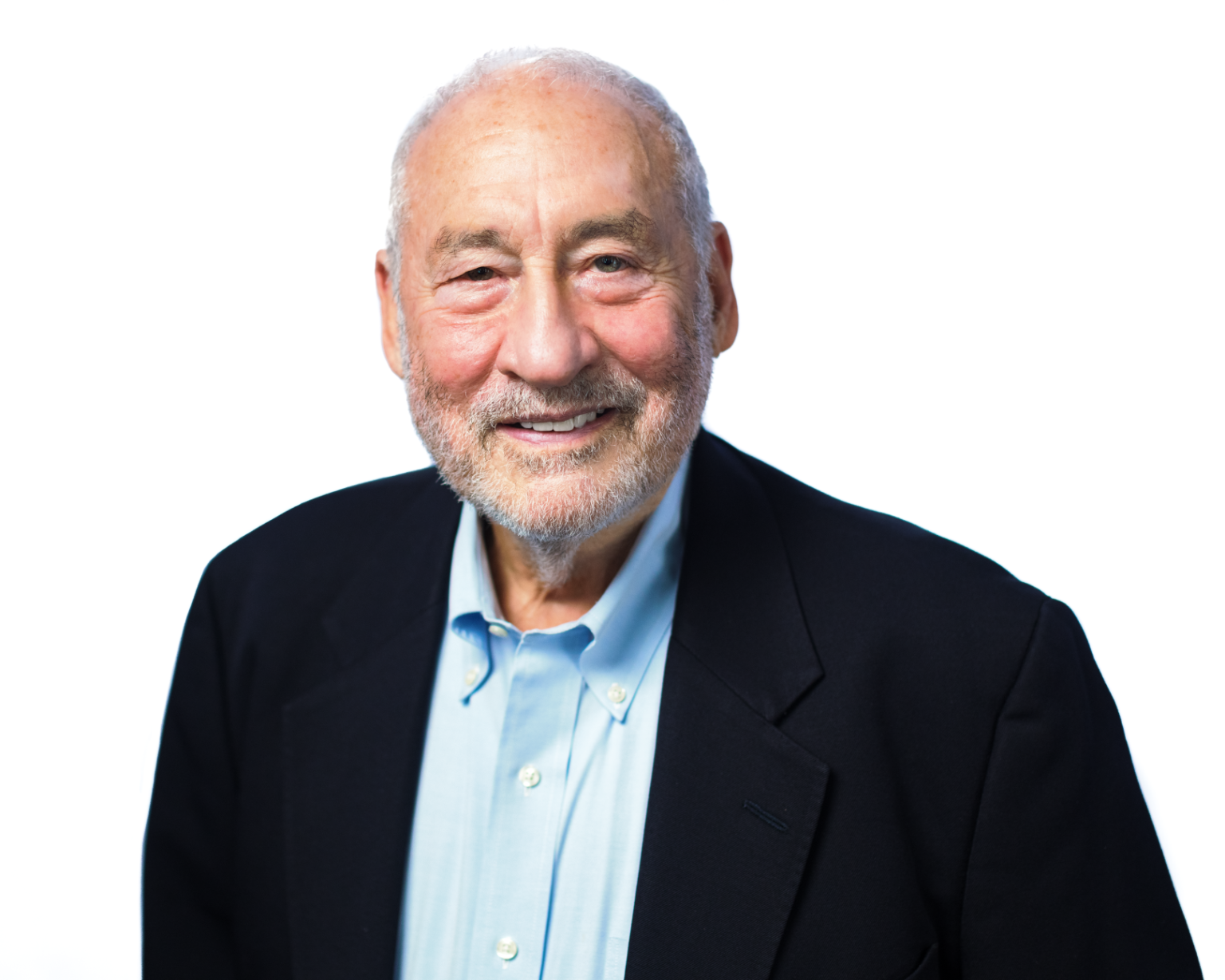
Joseph Stiglitz, American New Keynesian economist, a public policy analyst, political activist, and a professor at Columbia University.
To understand the situation, one must first understand the theory on which passive investing rests.
The EMH, which was primarily developed in the 1960s and 1970s, states that the market value reflects all available information. Its semi-strong form illustrates all publicly available information and in that case, because the majority of information is laid down on the table, no investor can outperform the market. Therefore, if prices are always right, paying active members to choose stocks is an expensive way to achieve market returns minus fees.
However, in 1980, Sanford Grossman and Joseph Stiglitz published a paper demonstrating that perfectly efficient markets cannot exist due to the expenses of gathering data. Because why should investors spend resources on discovering what prices already reflect? But in that case, if no one gathers information, prices have no mechanism by which to become efficient. This is the Grossman-Stiglitz paradox - prices must remain partially inefficient to compensate those who analyze the market, but at the same time, not so inefficient that passive strategies become unprofitable and that is a delicate balance. Additionally, active investors are the ones who bear the cost of price discovery, while passive investors benefit from it for free.
But, the economists at the time could not have fully predicted the scale at which passive investment would ultimately operate and what that scale would do to the equilibrium they were describing.
The Numbers That Should Give You PAUSE
The growth of passive investing represents a structural transformation of how capital markets function.
The three largest asset managers in the world are the dominant providers of index products (Vanguard, BlackRock and State Street) and collectively they own approximately between 20 and 22 percent of every company in the S&P 500, which comes as a consequence of investor flows into index products. When one invests in the Vanguard S&P 500 fund, their money is distributed across all elements regardless of whether they are efficiently run, fairly valued, or deserve capital.
The concentration within those benchmarks represents an escalating risk. Today, just ten mega-cap companies make up around 40% of the whole index. If they break, the investors are no longer safely diversified. Additionally, the computer program running the fund does not have valuation-based constraints, so it just keeps on buying stocks. Due to that automatic purchasing, the stock prices of leading companies may be artificially pushed up even higher. Therefore they would become a bigger part of the index.
The Index Effect: when Inclusion moves PRICES.
The index effect refers to the price changes and volume spikes that occur when a stock is added to or deleted from a major market index. That happens mechanically because rules require passive funds to buy or sell without the reassessment of the company’svalue.
This process is driven by several economic propositions. First, the price pressure hypothesis argues that the price spike is temporary, caused by a surge in buying pressure and that it will reverse once passive funds complete their rebalancing. Second, the imperfect substitutes hypothesis suggests that the price effect is permanent due to the significant reduction of available shares. Lastly, the liquidity hypothesis states that the price is affected because index-added stocks have a greater liquidity and reduced information asymmetry, which changes the required returns.
The index effect illustrates price changes without the additional fundamental information. It shows that when passive assets dominate prices move due to structural, mandatory money flows and not because something meaningful has changed in the business.
Yet the evidence complicates the alarmist reading. The index effect, measured at its peak in the 1990s, has substantially eroded over the past two decades - the abnormal return on inclusion, once estimated near 8%, has compressed toward statistical insignificance in recent samples. Two mechanisms explain the decline. Arbitrageurs, knowing precisely which stocks index funds are obligated to buy and on what schedule, increasingly trade ahead of the rebalancing and absorb the forced demand before it can move prices.
Meanwhile, the supply of shares has grown moreelastic, dampening the impact of any single mechanical flow. The implication is uncomfortable for both sides of the debate. The fading of the index effect is not evidence that passive flows are harmless; it is evidence that, for now, enough active capital remains to neutralize the distortion the moment it appears. The arbitrage is the price discovery - the very function the free-rider problem warns is disappearing. The question, then, is not whether passive investing has already broken the mechanism, but how thin the active layer can become before the arbitrage that currently corrects these distortions no longer arrives. The distortion is not absent. It is being held at bay by a shrinking number of participants, and no one knows the threshold at which their numbers become insufficient.
The Free Rider Problem at market Scale
In economics, passive investing is a free rider strategy because the passive investor benefits from a public good without contributing to its production. This is the point where individual and collective efficiency differentiate.
The process is analogical to a democratic election. In voting the probability of any single vote being decisive is very small. However, if everyone acted on this individual logic and abstained, the system would fail. Individual participation cannot be justified based only on self-interested grounds. Despite that, the value of the institution depends on active and meaningful participation. Markets behave similarly. Even though every individual participant would prefer for others to bear the cost of analysis, like institutions, pricediscoveryrequires enough participants to be willing to bear that burden.
Passive investing represents a prisoner’s dilemma at the scale of financial markets. Individual investors have a rational incentive to index but if all investors act on this individual logic simultaneously, the system, which produces those returns, may begin to weaken. The rational choice would be collectively self-defeating.
That does not mean that passive investing is wrong, it means that its validity as a strategy depends on conditions it cannot maintain on its own. Even with a large passive sector, markets can remain efficient if enough active managers perform the analytical work that prices require. The question is whether passive investing continues to work as it grows and what the consequences are in that situation.
Markets do not fail because everyone stops trading. They fail when the mechanisms that translate information into prices stop functioning, in ways invisible until the aftermath becomes difficult to ignore. So, the question that nobody has been able to answer yet is what happens when the borrowers become the majority and as always, the market will answer in its own time.
All data used in this article is derived from publicly available institutional reports and industry analyses.
This article is for informational purposes only and does not constitute investment advice.
Bibliography
U.S. Securities and Exchange Commission - Jack Bogle, Haystacks, and Putting the Interest of Clients First (2024)https://www.sec.gov/newsroom/speeches-statements/gensler-etam-051624
Apollo Academy - Assessing the Impact of Passive Investing over Time (2024)https://www.apolloacademy.com/wp-content/uploads/2024/11/Passive-Investing-Paper-vF-112224_STAMPED.pdf
American Century Investments - Passive Investing & Stock Prices: Myth vs. Reality (2024)https://www.americancentury.com/institutional-investors/insights/has-passive-investing-gotten-too-big/
Morningstar - Active/Passive Barometer: Year-End 2024 (2025)https://www.morningstar.com/funds/active-funds-trailed-passive-peers-2024
Investment Company Institute - ICI 2024 Fact Book (2024)https://www.icifactbook.org
Bloomberg Intelligence - Passive’s No Bubble as Active Retains Market Control (2025)https://www.bloomberg.com/professional/insights/trading/passives-no-bubble-as-active-retains-market-control/
RBC Wealth Management - The Great Narrowing: S&P 500 Concentration (2026)https://www.rbcwealthmanagement.com/en-us/insights/the-great-narrowing-sp-500-concentration
Guinness Global Investors - Is There a Rising Concentration Risk in the S&P 500? (2025)https://www.guinnessgi.com/insights/sp-500-concentration-risk
Osborne Partners - The S&P 500 Concentration (2025)https://osbornepartners.com/the-sp500-concentration/
GHP Investment Advisors - Concentration at the Top: What It Means for S&P 500 Investors (2025)https://ghpia.com/sp-500-concentration-implications-for-investors/
IR Impact - The Quiet Power of the Big Three: A New Era of Corporate Governance (2025)https://www.ir-impact.com/2025/07/the-quiet-power-of-the-big-three-a-new-era-of-corporate-governance/
U.S. News & World Report / ETF.com - These 3 Fund Families Control 74% of the Equity ETF Market (2024)https://money.usnews.com/investing/articles/these-3-fund-families-control-74-of-the-market
The Wall Street Journal - Bogle Sounds a Warning on Index Funds (2018)
State Street Global Advisors / Instinet - Closing Time: How Passive Investing Is Reshaping Equity Market Microstructure (2026)https://www.ssga.com/us/en/institutional/insights/how-passive-investing-reshaping-microstructure
Fama, E. F. — Efficient Capital Markets: A Review of Theory and Empirical Work. The Journal of Finance, Vol. 25, No. 2 (1970)
Grossman, S. J. & Stiglitz, J. E. — On the Impossibility of Informationally Efficient Markets. The American Economic Review, Vol. 70, No. 3 (1980)
Harris, L. & Gurel, E. — Price and Volume Effects... The Journal of Finance, Vol. 41, No. 4 (1986)
Shleifer, A. — Do Demand Curves for Stocks Slope Down? The Journal of Finance, Vol. 41, No. 3 (1986)
Appel, Gormley & Keim — Passive Investors, Not Passive Owners. Journal of Financial Economics, Vol. 121, No. 1 (2016)
Bebchuk & Hirst — Index Funds and the Future of Corporate Governance. Columbia Law Review, Vol. 119, No. 8 (2019)
Greenwood, R. — The Disappearing Index Effect. NBER Working Paper No. 30748 (2022)https://www.nber.org/system/files/working_papers/w30748/w30748.pdf
Federal Reserve Bank of New York — Is There an S&P 500 Index Effect? Staff Reports, No. 484 (2010)https://www.newyorkfed.org/medialibrary/media/research/staff_reports/sr484.pdf