Turning an Empire into a Balance Sheet.

London skyline, its skyscrapers, buildings, bridges and the Thames River.
Many may know it as one of the main villains in “Pirates of the Caribbeans”, but in reality it is much more than that.
Seldom does a company become big enough to influence events in a country or region and even fewer times does one turn into the main driver of the latter. In the case of the East India Company (EIC) however, its their financial power exceeded that one of the very empire that created it, turning a mud swamp given to it as an act of pity by one of the biggest empires in history into a machine that would one day topple that very institution.
To understand the reason behind the decision of founding such a company it is important to step out of the British Empire to look at the Iberian peninsula, both Spain and Portugal had been dominating trade with the East for the majority of the 1500s. However after defeating the Spanish Armada in 1588 and winning the Anglo-Spanish war, an opening materialized for the island to rise to new heights, but what they achieved with the mixture of financial, social, political and military strategies went beyond everyone’s wildest expectations. So how did they achieve such astonishing results and how are the techniques pioneered by them still relevant today?
There is a reason why, to this day in fictional stories such as Dune or Star Wars, spices play a central role. As it often times happens, inspiration came from past events, in particular the Dutch were the first ones to really grasp their importance: while the Spaniards and Portuguese focused on rare minerals such as gold, merchants from the Netherlands understood the value of importing and trading spices from the Far East, in a move that today is known as cutting out the middle man.
The intrinsic value of spices wasn’t as high as that of rare metals. They were easier to find, others were more willing to trade them with Europeans and yet this good faced an external limitation greatly hindering its trade: for centuries Arabs held the hegemony over trade with the East, inflating prices, but new maritime routes changed the equilibrium of power opening new, extremely lucrative opportunities for those who dared to embark on the treacherous voyage sailing past the Cape of Good Hope all the way to the East and back to European ports.
Albeit profitable, these journeys were plagued by illness, sailing risks and fierce competition from other superpowers, above all from the Dutch and their East India Company, which up to that point was the undisputed leader of trade with Asia.
For this reason the decision was made that the British answer would be funded by joint stocks rather than government funding alone. The Crown granted them the Royal Charter in 1600, but the money itself, around 70000£, was raised from more than 200 founders, this way the risk bearers shifted from the institutions to the investors. This way, under the control of the 24 elected directors led by Sir Thomas Smythe and armed with a British monopoly, Sir James Lancaster, 500 men and 5 ships embarked on the maiden voyage in 1601 coming back with 500 tonnes of pepper and marking the first profits.
It is also worth noting that the EIC paved the way for the modern corporate structure, having a Court of Directors, who would frequently report to the General Court of Proprietors, fundamentally paving the way for the modern relationships between the Board of Directors and the shareholders. Unlike other companies at the time it also switched from a product-centered view to a profit maximization approach, which is ultimately what led it to become arguably the most influential company in history.
As a matter of fact, the original targets were islands in the Southeast, rich in spices. However, the presence of the Dutch hindered the profitability and economies of scale. Thus, instead of focusing on the initial aim, the company pivoted to India and its textile industry, which was a justifiable risk and realignment, as according to Angus Maddison’s estimates, the British contribution to global GDP of 1.8% paled in comparison to the 25% of the Indian area. This mixture of spices and fabrics led to never before-heard returns, spanning from an average of 30% to heights of 400% on specific rarities such as nutmeg.
The expansion in the region was not without challenges however, as the Indian area was under the control of the Mughal Empire. Emperor Jahangir, the ruler when the first ships arrived, ruled the richest empire of the time with mega cities and one of the best armies in the world; therefore there was no interest in succumbing to trading obligations with a newly formed company. The first attempts to achieve exclusive trading treaties failed miserably with the emperors mocking the envoys from the EIC and their insignificance, notably Sir Thomas Roe spent 4 years (1615/1619) negotiating in Surat on behalf of King James I and yet he failed to obtain what he was seeking.
The only reason the company got any concessions, mainly some factories in Surat and the Gujarat ports, is to be found in its victory against the Portuguese in 1612 at the battle of Swally. This show of force convinced the Mughals to support a limited British enterprise to counter Portugal’s influence in the area, ultimately however, this underestimation cost the empire its own existence in less than 250 years.
Albeit humiliated, the EIC had tasted unseen amounts of profits and they realized that what they needed to do was to wait, bite the bullet and submit to the emperors, awaiting an opening that would allow them to become the dominant force in the region. However, before that they would go on to commit a mistake that would almost cost them everything.
Another concept found in modern finance pioneered by the EIC is the strategy of investing in marginal, less expensive land in order to streamline production and distribution: the company received as part of the wedding gift of King Charles II and the Portuguese princess, seven swamp islands renamed Bombay, which they turned into a fortified hub with piers capable of hosting every British ship without the costs of management imposed by the Mughals, this is the same strategy employed by companies such as Amazon, UPS and FedEx, where provincial, less expensive and abundant land is used to build distribution hubs, allowing for optimal storage and distribution at reduced operating costs and avoiding higher taxes imposed in densely populated areas.
The EIC however fell victim to its own success and committed a dangerous mistake: the empire was entangled in a prolonged conflict that was draining their resources and armies. Therefore Sir Josiah Child, director of the company, ordered a series of sieges to take with force what the company wanted. This, however, backfired as he had underestimated the sheer numbers of the Mughal armies.
British infantry was better and their muskets and ships were far superior, but the enemy was numerous and their counter sieges were never-ending, so, in the end emissaries from the EIC had to bow in front of Emperor Aurangzeb and humiliatingly beg for forgiveness, which was ultimately granted because of the role of the British in controlling the waters. Therefore, operations resumed in Surat, Bombay and new openings were made in Calcutta and later in the rich Bengal region.
This setback was due to the misreading by Child of the situation, as he had never been to India he misread the reports. However, what he lacked in military decision-making he made up for in financial and political skills, perfecting another strategy well known to the modern economic world, especially in the USA: government lobbying. He crucially flipped the equilibrium of power in the charter for the company taking advantage of the political turmoil afflicting the British Crown in those years, which left the latter lacking funds.
The director stipulated the payment of a pension to the king to ensure the renewal of the charter indefinitely (at least in the beginning) achieving a monopoly on the market in the country, in this situation the company does not allocate resources to fighting off competitors, as the latter do not exist. This allowed for a significant increase in the company’s military power to the point where their standing army was double the size of that one of the empire; at this point the company had overtaken the very movement that created it, all the while waiting for a power struggle in the Mughal Empire that it could use to take full control of the region.
After the death of Emperor Aurangzeb the empire fell into a succession crisis which weakened the throne. Right there and then a man climbing the ranks of the EIC saw the opportunity to enact a financial maneuver that would generate so much wealth that it would end up creating the first self-made millionaires generation in British history; that man’s name was Robert Clive and what he was planning was one of the greatest leveraged economic regime changes in history.
This tactic has been used over and over in history, for example by the USA in South America during the Cold War. It consists of leveraging economic factors to induce a change in government, in particular in the case of the Mughal Empire, the key was understanding where the real economic power dwelled and finding a way to transfer it from the hands of the emperors to the offices of 17-21 Leadenhall Street in London.
As proven by their prior military loss and humiliating defeat, military action against the Emperor was a costly and dangerous ultimately unfeasible option. Therefore, the company switched strategy and waited for someone else to do it, and when in 1739 Nadir Shah of Persia defeated and raided the empire, leaving a hole of an estimated £32 million sterling, Clive went to work.
The Jagat Seths were, in the words of the EIC's own official historian Robert Orme, the greatest bankers and money changers in the world at the time; as they controlled the cash flow from Bengal, the richest region in India and had monopolies on the collection of taxes, minting of coins and lending to companies their influence was comparable to the Rothschilds in Europe.
After the defeat of the Persians, Siraj-ud-Daulah, the Nawab of Bengal ,demanded 30 million rupees from the Seths, and when they refused he struck them, effectively alienating the monetary power from the institutional one. Right then Robert Clive met with the bankers and promised them the safety of their wealth, the proposal resonated with them and troops rolled into battle once more.
This time however they played it differently approaching Mir Jafar, one of the Nawab’s commanding officers, promising him the title in exchange for indemnity, land and trading privileges, while the bankers would provide a massive sum of rupees as payment. The funding and the future prospects were fundamental for the EIC, which, albeit significantly inferior (3000 vs 50000 troops), managed to win the Battle of Plassey in 1757 through the betrayal of Jafar and superior training and logistics; at this point the Seths thought they had solidified their hold on the region. Unbeknownst to them, however, they had just signed their doom.
The takeaway from this venture for the EIC was that the key to achieving maximum growth and control was not horizontal expansion alone through numbers, but the integration of vertical expansion. In particular, the bankers at the time held their grip through the ability to control the coin, so that was going to be the next target. First of all, they leveraged distrust between Jafar’s successor and the Seths to have the former assassinate the latter, and then they moved to swoop away their privileges.
The company managed to move the Bengal mint from Murshidabad to Calcutta where they had hegemony over it. This way the cash flow they first sought from the Mughals and then from the Seths was now in their control and they became the decision maker in the region, deeply forwarding their interests and free trade accords. The result was that the already staggering returns increased even more and by the second half of the 18th century the company’s stock soared.
At the same time officers who had joined the company years prior due to lack of other opportunities had now access to the treasury of Murshidabad enriching themselves greatly and returning to England as the first generation of self-made multimillionaires in English history and adding a new word to their dictionary, this was, in fact, the birth of the word “loot”, that would go on to become one of the most popular ones in use at the time.
Part of the expansion process was direct annexation of territories in the name of the English Crown with a strategy often used by colonial powers: finding lesser/oppressed factions and rally them against the main local power and then setting up a Princely state which would support a stable British garrison for security and administrative duties. At first, the approach was defensive, afterwards, the doctrine became more and more aggressive and more and more resented, sparking many revolutions which would be a constant during the years of occupation. This strategy is a classical example of contractual terms tightening with security concerns as justification.
An initial defensive perimeter is substituted by forced subsidiary alliances and finally with a confiscatory policy in case of missed payments or dynastic disputes. Once the company had obtained the monopoly, however, the operational costs still increased as it became harder and harder to maintain control. For this reason Governor General Richard Wellesley forwarded the career of his younger brother Arthur, a move which created some friction with senior command, and albeit some protests may have been valid, this decision would soon prove more significant than anyone could have expected as not only he proved to be one of the most effective commanders of the Indies, but also, years later that very “product of nepotism” would go on to save the British Empire and defeat Napoleon at Waterloo.
At its peak the company had unheard numbers at the times: it employed around 280,000 soldiers, double the number of the British Empire, controlled two thirds of the subcontinent and more than 200 million citizens under their control, 40 to 50 ships sailing each year, a share price of £284 stock valuation in 1769, a 10% dividend and share capital of £3.2 million.
Under the surface however hidden problems dwelled between the books: the stock was overvalued while a famine in Bengal caused a shortage in revenue, instead of addressing the issue company officials turned the way to fraud, for instance in 1770 the directors authorized £212,000 in bills of exchange from India. Their servants however ended up issuing £1,000,000, which meant that the sold merchandise did not cover their ultimate value; furthermore the company sat on more than 15 million lbs. of unsold tea, while in the American colonies the majority of the tea consumed was smuggled Dutch tea.
A Scottish investor by the name of Alexander Fordyce opened a short position against the company of £1,000,000. However, when the stock did not fall fast enough he had to flee to France leaving debts behind and causing multiple banks to fail, albeit his timing was wrong, his data wasn’t: the difficulties started to surface and the company had to slash dividends to 6% and lost a third of its stock valuation, at this point nothing could be hidden anymore and the EIC, now blacklisted from taking out loans from financial institutions, had to seek help from the government.
When not even a loan for £400,000 was enough, the only solution became a government bailout, and the state had great interest in doing so as many MPs held major investments in the firm and the company was not only responsible for a tenth of the entire British Exchequer's revenue through duties on imports, but also for paying an annual tax of £400,000 to the Treasury for their territorial revenues. Therefore, a multi step bailout was approved.
First of all, the Bank of England approved a loan of £1.4 million at a low 4% interest to serve as cash injection. In the meantime the Tea Act of 1773 was enacted to give the company direct trade with the colonies without customs duties in England and with enhanced taxes collected from the colonies. This of course came, with severe strings attached in the form of the Regulation Act of 1773, introducing a dividend cap and, for the first time, direct government participation in the company's Indian affairs and board oversight, but there was another consequence they did not anticipate.
The colonies in America refused the extra taxation, which was the last of a series of issues which led to the Boston Tea Party, the Revolutionary War and the birth of the United States of America.
and Nationalization
One of the biggest blows to the company came in 1813 with the Charter Act, removing its monopoly on Indian trade and the Act of 1833 removed its commercial power all together relegating the EIC to a purely administrative company. The equity was converted with shareholders accepting a guaranteed 10.5% annual dividend for forty years, funded from Indian tax revenue, this move sparked controversy in England as the idea of delegating governing duties to a joint-stock association was seen as “preposterous”.
Another big blow came from a series of revolts in 1857; this had been a constant. However, the latter, unlike the others, stemmed from the very ranks of the EIC’s military force, as its ranks were mainly composed of Indian soldiers. Both Hindus and Muslims, it is important to know that at the time musket cartridges had to be bitten in order to be opened and used. The issue was that their newly issued Enfields P-53 cartridges were allegedly greased with pork and cow fat, offensive to both cultures.
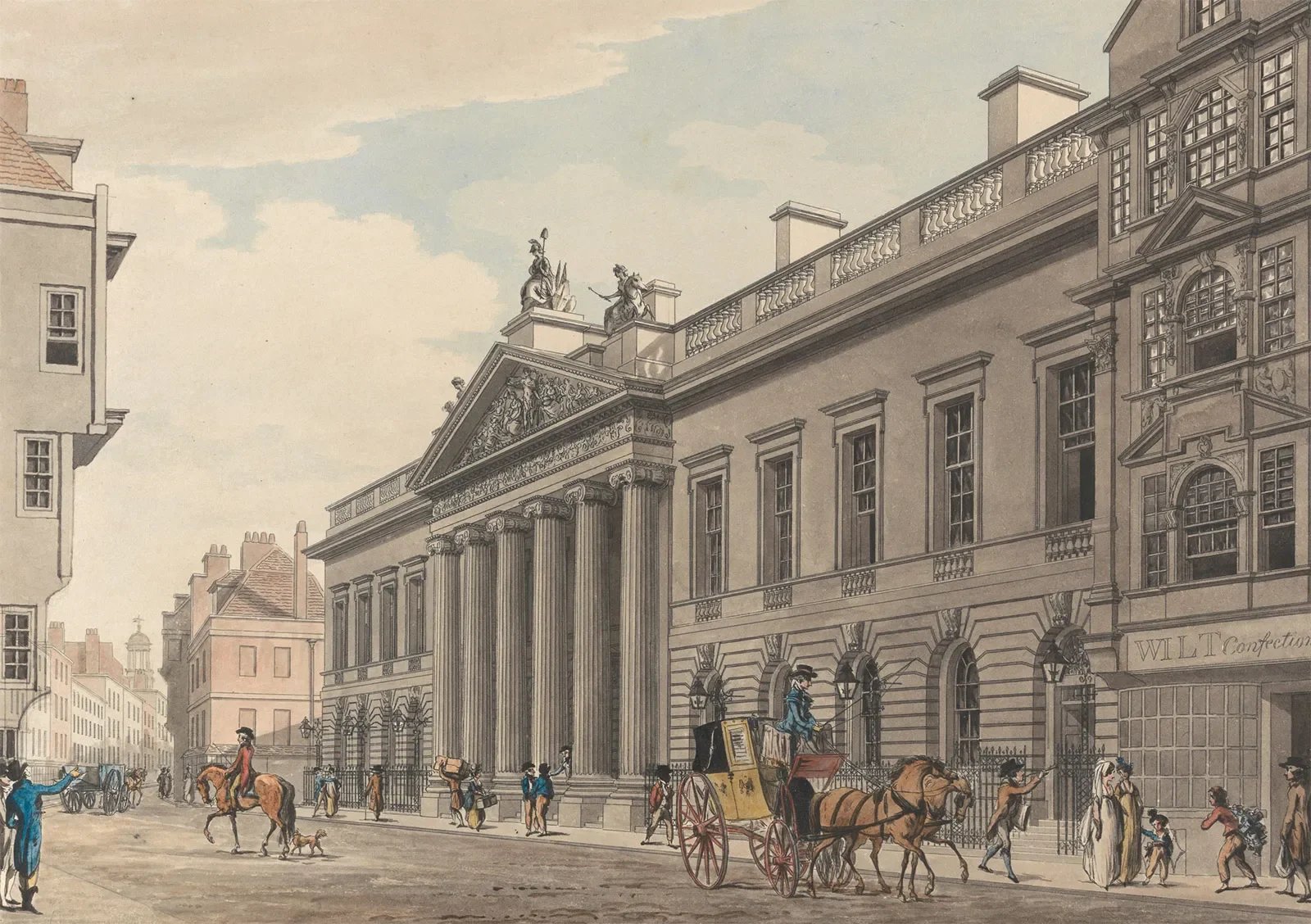
East India Company, HQ London.
Not all regions registered uprisings, but the ones that did in central India registered atrocities from both sides. The inability of the EIC to control the situation efficiently from the EIC caused Parliament to consider the venture over and, on August 2nd 1858 the official takeover by the Empire occurred, turning the EIC’s mandate into the British Raj. Finally, the East India Stock Dividend Redemption Act 1873 was the final act to dissolve the company: stock was commuted by agreement or compulsorily redeemed at £200 for every £100 of stock, a 2× par buyout, after four decades of a state-guaranteed 10.5% coupon paid by the taxpayers of the territory the company had ruled.
The EIC was not the first trading company to be listed on a stock market. As a matter of fact the Dutch East India Company (VOC) was the first one to swap the traditional single voyage funding for a permanent capital stock purchasable by any citizen of the Dutch Republic with its IPO in 1602, this model would then go on to be widely used, ushering in a new era and facilitating the transition into a market accessible to the public.
A byproduct of this approach was the Amsterdam Stock Exchange, the very first of its kind, as this new system required a medium through which individuals could sell and buy stocks from one another, it is therefore possible to state that trading companies are what started modern finance as we know it. As a matter of fact, they also introduced the first ever stock trading book: the “Confusión de Confusiones” by Joseph de la Vega.
This rise catalyzed by the VOC however almost immediately presented classical issues of the markets we have learned to know today: overvaluations, stock crashes and even history's first documented bear raid. In 1609/10 Isaac Le Maire, an ex-VOC director, utilized collateral-free forwards to enact the raid. The pressure put on by this action led to another of the most famous traits characterizing stocks, as the VOC decided to pay its first dividends, in the form of mace, a surplus spice it couldn't sell; there had been earlier recorded payments of dividends in history, with the first one being in France, however this was the first time such a principle was tied to a publicly traded financial instrument.
Over its life the VOC sent 4,785 ships east; the EIC managed only 2,690 and one-fifth the tonnage, however, albeit the first would go down as one of the most profitable and highly valued companies in history (at €1 billion in today's money and a stock price of 1,200% of par); and yet somehow it was the EIC to become the true historical colossus of eastern trading, but why?
The reason is that the EIC understood that in order to become the better company, it had to transcend the very definition of one: they were the first corporation to understand that money and power didn’t reside within the product but rather in the system that created it, therefore while the VOC invested in the spices and products in high demand and at a high price, the EIC understood that trends change, land, taxes and control don’t.
That is why their focus was on obtaining control of the minting process of coins and governance of the land rather than the product the mills and factories produced, a more recent example is the case of Netflix vs Blockbuster, while the second bet all its resources on the product, the first bet on the distribution system, and that is why when people shifted from tapes to streaming one survived and the other didn’t. Just like coining for the EIC, Netflix also started heavily investing in its own TV series: House of Cards, Stranger Things etc., understanding that controlling the creation process itself granted them total control and high returns.
Another aforementioned example is Amazon and the way they focus more on the distribution chain rather than the products themselves. It lets the sellers price and develop the goods, their real asset is the distribution, not only of physical objects but also of Cloud and online services, making it immune to shifts in trends; after having consolidated its their base, it also started “minting” it own products with the Amazon Basics line and pushing some others through Amazon Choice, solidifying their control over an already existing market.
A common term today for companies such as the EIC is “too big to fail”, this doesn’t only mean that their dimensions and resources make it so it is very unlikely for them to implode, but also that they cannot be left to do so even if the conditions are there, for example Bear Stearns in 2008; the key factor is that big corporations are too important for the economy for a government to let them fail: too many jobs, income from taxes and market shares would be lost and therefore states themselves will intervene to aid a bailout.
In the case of the EIC for example this is even more prominent as the company itself also had administrative duties in the Indies and was responsible for the remuneration of the Crown itself, and in this complexion of factors lies the reason why the government went above and beyond to fund and save the EIC, stretching its existence until the situation became too dire. The EIC wasn’t just a company, it was the extension an entire Empire depended upon, and this gave birth to the first ever multinational corporation in modern terms.
Comparing it with the VOC for instance, albeit the second was technically larger, the Dutch limited themselves to trade, operating effectively with authority only in the Netherlands, whereas the EIC expanded and became the state in the Indies, it had factories, ports, armies, banks etc. not through concession but rather through sheer ownership, even the charter and monopoly from the Crown at one point became just a facade, as even if they wanted to remove it, it wouldn’t have changed the situation as the EIC was effectively post- government, and only after financial troubles the Crown had grounds to remove the monopoly without risking its own stability.
It is this very trait of the EIC that inspired modern-day policies on capping the power and influence of corporations today, as people had now seen first hand a company becoming super partes to the political world, prompting discussions over the point of a government’s role in regulating enterprises and markets. From the swings of the Amsterdam Stock Exchange, the EIC, different bubble bursts and so many more examples the modern, political philosophy has been challenged and evolved, shaping positions and ideals that created pillars of today’s economic and social world, from regulatory agencies to the EU.
Another aspect that would characterize the modus operandi of the company was the absolute disregard for anything not related to profit increase. There is one reason for this, besides the obvious, which opens a new debate among lawmakers and regulators to this day: when providing the royal warrant granting monopoly on East India trading, there was a clause in the contract that few know about. The validity was contingent on the profitability of the company, meaning that the company had to be more and more profitable, as otherwise it would have lost the right to the monopoly, which is something they couldn’t afford.
The original justification of this idea is based on a reasonable economic tactic: since the Empire was already behind its European rivals, the only way to catch up and secure such a key region was to have a company big enough to bear the great expenses of trading on those routes and the multiple associated risks, in order to create such an entity it was therefore key to also provide the prospect of high returns and the only way to obtain such possible returns was to ensure that the entire trade would be controlled by a single corporation.
This however is not a flawless approach, with the lack of competition comes a lack of incentives to improve and innovate, the failsafe for the deal was the clause in the charter.
However this very measure backfired greatly: with the prospect of losing their hegemony the company often resorted to manipulation of statements and brutal retaliation against the local population.
This not only led to constant revolts in the Indian territories, but also forced the state to execute a very expensive bailout when eventually all this fraud caught up with the EIC.
To this day the debate is as heated as ever as for decades now corporate benefits for shareholders and managers have been considered a staple of contract stipulation.
Another aspect that would characterize the modus operandi of the company was the absolute disregard for anything not related to profit increase. There is one reason for this, besides the obvious, which opens a new debate among lawmakers and regulators to this day: when providing the royal warrant granting monopoly on East India trading, there was a clause in the contract few know about. The validity was contingent on the profitability of the company, meaning that the company had to be more and more profitable, as otherwise it would have lost the right to the monopoly, which is something they couldn’t afford.
The original justification of this idea is based on a reasonable economic tactic: since the Empire was already behind its European rivals, the only way to catch up and secure such a key region was to have a company big enough to bear the great expenses of trading on those routes and the multiple associated risks, in order to create such an entity it was therefore key to also provide the prospect of high returns and the only way to obtain such possible returns was to ensure that the entire trade would be controlled by a single corporation.
This however is not a flawless approach, with the lack of competition comes a lack of incentives to improve and innovate, the failsafe for the deal was the clause in the charter.
However this very measure backfired greatly: with the prospect of losing their hegemony the company often resulted in manipulation of statements and brutal retaliation against the local population.
This not only led to constant revolts in the Indian territories, but also forced the state to execute a very expensive bailout when eventually all this fraud caught up with the EIC.
To this day the debate is as heated as ever as for decades now corporate benefits for shareholders and managers have been considered a staple of contract stipulation.
An example of this is the Enron Scandal and, if on one side, this kind of clauses and bonuses can lead to malpractice it is also true that most of the time they also push for genuine efforts by the interested parties. The key, as always, is the way companies are overseen and malpractices punished, hence, considering it is human nature to make mistakes and wrong choices. Once again, the law is the key to ensure it is more convenient to comply than to cheat.
For so long now the principal-agent problem has been discussed and tackled, and yet when it comes to politicians the stakes are even higher as their control transcends the corporate sphere including the public one, so how is it that a solution is still elusive.
The reality is that as it often is the case, the right choice is in the middle, and the latter is not always easily spotted: on one side the argument is that trading stocks when one is a member of the very body regulating, deciding and awarding contracts is simply too unfair to be allowed; on the other hand the baseline is that stocks and markets are a method to grow wealth, especially when considering the effects of inflation and other variables, and therefore should be at least in part allowed.
If the second seems reasonable, the issue lies once again in human nature, as when given advantages it is expected that one might try to overexploit them, in the case of the EIC the picture is more ambiguous than most imagine.
At first glance it appears clear that the decision to manipulate the books was a decision taken only in the interest of shareholders. The reality is that the EIC brought in so much monetary and administrative resources that the benefits were not limited to shareholders but rather to the entirety of the Empire; it would therefore be hasty to assume that the broader public would have acted or demanded differently had they known the truth.
More Godfather
In conclusion, the EIC is, to this day, the perfect example with which to analyze the functioning, strengths and weaknesses of a multinational corporation, because of the scope of its operations and influence, together with the fact that it was disbanded and its secrets are now available to everyone. An analysis of the EIC shines a light on the functioning of the modern corporate world; to sum everything up: the EIC is less the villain of a mythical pirate adventure and more the godfather of modern behemoths of international markets.
ICore Histories of the Company
Dalrymple, William. The Anarchy: The Relentless Rise of the East India Company London: Bloomsbury, 2019.The essential modern narrative — trading corporation to territorial sovereign.
Robins, Nick. The Corporation That Changed the World 2nd ed. London: Pluto Press, 2012.Frames the EIC as ancestor of the modern multinational; the piece's central thesis.
Keay, John. The Honourable Company: A History of the English East India Company London: HarperCollins, 1991.Charter to dissolution; Surat, Bombay, the Anglo-Mughal war, Wellesley.
Stern, Philip J. The Company-State: Corporate Sovereignty and the Early Modern Foundations of the British Empire in India Oxford: Oxford University Press, 2011.The scholarly case that the Company held sovereignty long before formal empire.
Bowen, H. V. The Business of Empire: The East India Company and Imperial Britain, 1756–1833 Cambridge: Cambridge University Press, 2006.Authoritative on finances, stockholding, dividends and the Charter Acts.
Erikson, Emily. Between Monopoly and Free Trade: The English East India Company, 1600–1757 Princeton: Princeton University Press, 2014.On the joint-stock structure, private trade and network behaviour.
IIThe Joint-Stock Structure & Corporate Form
Chaudhuri, K. N. The English East India Company: The Study of an Early Joint-Stock Company, 1600–1640 London: Frank Cass, 1965.Founding capital, the ~200 subscribers, the ~£70,000 raised, the Court of Directors.
Chaudhuri, K. N. The Trading World of Asia and the English East India Company, 1660–1760 Cambridge: Cambridge University Press, 1978.Quantitative backbone for trade volumes, returns and the textiles pivot.
Scott, William Robert. The Constitution and Finance of English, Scottish and Irish Joint-Stock Companies to 1720 3 vols. Cambridge University Press, 1910–12.Early share capital, the board–shareholder relationship and dividend practice.
Smith, Adam. An Inquiry into the Nature and Causes of the Wealth of Nations (Book V) London, 1776.PrimaryContemporary critique of the monopoly and its governance.
IIIThe Indian Economy & the Pivot to India
Maddison, Angus. Contours of the World Economy, 1–2030 AD Oxford: Oxford University Press, 2007.Primary source for the “1.8% vs 25%” contrast in world GDP shares.
Maddison, Angus. The World Economy: Historical Statistics Paris: OECD Development Centre, 2003.The dataset behind the above; cite alongside Contours.
Maddison, Angus. Class Structure and Economic Growth: India and Pakistan since the Moghuls London: Allen & Unwin, 1971.Aurangzeb-era revenues and the scale of the Mughal economy.
Tharoor, Shashi. Inglorious Empire: What the British Did to India London: Hurst, 2017.Popular synthesis of the Maddison extraction thesis; framing, not primary data.
Parthasarathi, Prasannan. Why Europe Grew Rich and Asia Did Not, 1600–1850 Cambridge: Cambridge University Press, 2011.Indian textile competitiveness — context for the pivot and the return range.
IVMughals, Surat, Swally & Bombay
Foster, William (ed.). The Embassy of Sir Thomas Roe to the Court of the Great Mogul, 1615–1619 London: Hakluyt Society, 1899.PrimaryRoe's four-year negotiation with Jahangir; the failed exclusive treaties.
Foster, William. England's Quest of Eastern Trade London: A. & C. Black, 1933.Lancaster's 1601 voyage, the Battle of Swally (1612), Surat and the Gujarat ports.
Richards, John F. The Mughal Empire (New Cambridge History of India I.5) Cambridge University Press, 1993.Jahangir and Aurangzeb; the strength of the Mughal state.
Watson, I. B. “Fortifications and the ‘Idea’ of Force in Early EIC Relations with India,” Past & Present 88 (1980): 70–87.Force, factories and the Anglo-Mughal confrontation.
VClive, the Jagat Seths & Plassey (1757)
Encyclopædia Britannica. “Battle of Plassey” (reference entry).Confirms Clive's ~3,000 against the Nawab's ~50,000; victory by Mir Jafar's defection.
National Army Museum. “The Battle of Plassey” (nam.ac.uk) (reference entry).The Jagat Seths' fear of Siraj-ud-Daulah and the secret deal to install Mir Jafar.
Marshall, P. J. Bengal: The British Bridgehead, 1740–1828 (New Cambridge History of India II.2) Cambridge University Press, 1987.The post-Plassey settlement, the revenue grab and the mint.
Orme, Robert. A History of the Military Transactions of the British Nation in Indostan 3 vols. London, 1763–78.PrimaryThe Company's own historian — origin of the “greatest bankers” line on the Jagat Seths.
Axworthy, Michael. The Sword of Persia: Nader Shah London: I. B. Tauris, 2006.Nadir Shah's 1739 sack of Delhi — the shock to the Mughal treasury.
VIThe Mint, “Loot” & the Nabobs
Marshall, P. J. East Indian Fortunes: The British in Bengal in the Eighteenth Century Oxford: Clarendon Press, 1976.The fortunes made after 1757, the returning nabobs, the drain from Murshidabad.
Oxford English Dictionary. s.v. “loot, n.” (from Hindi lūṭ) (reference entry).First English attestations of the word in the EIC / Bengal context.
VIIExpansion & the Wellesleys
Bayly, C. A. Indian Society and the Making of the British Empire (New Cambridge History of India II.1) Cambridge University Press, 1988.Subsidiary alliances, the princely-state system, tightening “security” terms.
Cooper, Randolf G. S. The Anglo-Maratha Campaigns and the Contest for India Cambridge University Press, 2003.Arthur Wellesley's Indian command under his brother Richard.
Holmes, Richard. Wellington: The Iron Duke London: HarperCollins, 2002.The Arthur Wellesley → Wellington → Waterloo thread.
VIIIThe 1770 Crisis & the 1772–73 Bailout
Kosmetatos, Paul. The 1772–73 British Credit Crisis Cham: Palgrave Macmillan, 2018.The definitive modern monograph: Fordyce, the bank runs, the near-collapse, the rescue.
Sutherland, Lucy S. The East India Company in Eighteenth-Century Politics Oxford: Clarendon Press, 1952.Colebrooke's stock “corner” and the bailout politics.
Bowen, H. V. “Investment and Empire: East India Stockholding, 1756–1791,” Economic History Review 42:2 (1989): 186–206.Share-price behaviour and the stockholding base.
IXThe Tea Act, the Regulating Act & America
Parliament of Great Britain. Regulating Act 1773 (13 Geo. 3 c. 63) & Tea Act 1773 (13 Geo. 3 c. 44) legislation.gov.uk.PrimaryFirst direct government oversight of the Company; direct tea export to the colonies.
Labaree, Benjamin Woods. The Boston Tea Party New York: Oxford University Press, 1964.The colonial reaction, the tea glut, smuggled Dutch tea, the road to revolution.
XRevolt, Nationalisation & Dissolution
David, Saul. The Indian Mutiny: 1857 London: Viking, 2002.The Enfield P-53 cartridge grievance and the sepoy composition of the army.
Mukherjee, Rudrangshu. Awadh in Revolt, 1857–1858 Delhi: Oxford University Press, 1984.The atrocities on both sides in central India.
Parliament of the UK. Government of India Act 1858 (21 & 22 Vict. c. 106); Charter Acts 1813 & 1833; East India Stock Dividend Redemption Act 1873 (36 & 37 Vict. c. 17) legislation.gov.uk.PrimaryCrown takeover and the British Raj; monopoly removed; the 2×-par redemption and dissolution.
XIThe Dutch Comparison — VOC & the Amsterdam Exchange
Petram, Lodewijk. The World's First Stock Exchange New York: Columbia University Press, 2014.The VOC's 1602 IPO, the exchange, Le Maire's 1609–10 bear raid, the early dividends.
de la Vega, Joseph (Penso). Confusión de Confusiones Amsterdam, 1688.PrimaryThe first book to describe a stock exchange.
Bruijn, J. R., F. S. Gaastra & I. Schöffer (eds.). Dutch-Asiatic Shipping in the 17th and 18th Centuries 3 vols. The Hague: Martinus Nijhoff, 1979–87.The authority for the VOC ship count (~4,722 outward voyages, 1595–1795).
de Vries, Jan. “The Limits of Globalization in the Early Modern World,” Economic History Review 63:3 (2010): 710–33.Comparative Euro-Asian shipping and tonnage — the VOC-vs-EIC volume claim.
Gaastra, Femme S. The Dutch East India Company: Expansion and Decline Zutphen: Walburg Pers, 2003.Overview: dividends, capital and the VOC's scale versus the EIC.
XIIThe Modern Parallels
Sorkin, Andrew Ross. Too Big to Fail New York: Viking, 2009.Bear Stearns and the 2008 rescues — the “too big to fail” logic.
McLean, Bethany & Peter Elkind. The Smartest Guys in the Room: The Fall of Enron New York: Portfolio, 2003.The profit-clause / incentive-to-defraud argument.
Keating, Gina. Netflixed: The Epic Battle for America's Eyeballs New York: Portfolio, 2012.“Bet on distribution, not the product” — Netflix vs Blockbuster.
Stone, Brad. The Everything Store: Jeff Bezos and the Age of Amazon New York: Little, Brown, 2013.Distribution, AWS and Amazon Basics — controlling the system, not the product.
Primary legislation is cited from legislation.gov.uk. Where a work is listed against a specific figure, that work — not a tertiary source — is the intended footnote.